

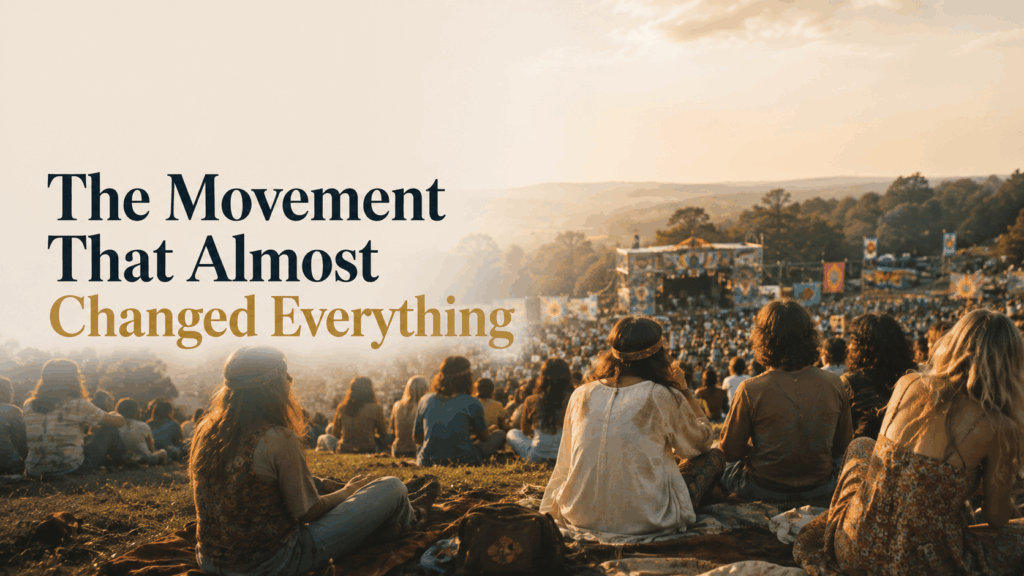
There was a time when millions of people looked at the world around them and simply said:
No.
No to war.
No to hatred.
No to racism.
No to blind obedience.
No to judging people because they were different.
And perhaps most importantly:
No to the idea that we had to keep living the way we had always lived.
The 1960s and 1970s were more than a protest movement.
For many people, they were a reawakening.
Young people marched for peace. They challenged governments and questioned authority. They rejected old social rules and demanded greater freedom.
The counterculture brought together music, art, community, free expression, experimentation, and a growing belief that human beings could relate to one another with less judgment and more compassion.
But something else was happening beneath the surface.
People were searching for God.
Not necessarily the God they had been taught about as children, and not necessarily through traditional religious institutions.
They wanted to experience something for themselves.
They explored meditation, Eastern philosophy, yoga, chanting, mysticism, nature, consciousness, and spiritual practices from cultures around the world.
Books about spirituality and consciousness passed from hand to hand. Meditation and yoga became increasingly visible in Western culture. Young people traveled to places such as India in search of teachers, traditions, and answers to questions they felt their existing culture had not answered.
Religion itself was being questioned.
For many, the question was no longer simply:
“What religion are you?”
It became:
“What do you believe? What do you experience? What is God? Why are we here?”
This was the beginning of a much more grassroots approach to spirituality.
You didn’t necessarily need someone standing in front of you telling you what God was.
You could sit quietly.
You could meditate.
You could look at the stars.
You could walk through nature.
You could open your heart.
You could search.
And perhaps you could discover something within yourself.
What Was the Spiritual Awakening of the 1960s and 1970s?
The spiritual side of the counterculture was part of a much larger cultural transformation.
The period saw growing interest in Eastern religious and philosophical traditions, meditation, yoga, mysticism, alternative approaches to consciousness, communal living, and forms of spirituality outside conventional religious institutions.
For some people, this wasn’t about abandoning religion altogether.
It was about finding a more personal relationship with spirituality.
Instead of simply accepting beliefs because an institution or authority figure presented them, people increasingly wanted to experience spirituality for themselves.
This distinction is important.
The movement wasn’t one single organized religion or philosophy.
It was a collection of different ideas, movements, communities, and individuals who often disagreed with one another.
But many shared a desire to question established assumptions.

Why Were Young People Questioning Traditional Religion?
The reasons were complicated.
The postwar generation had grown up during enormous political and cultural changes.
They saw racial injustice.
They saw the Vietnam War.
They witnessed political conflict and social inequality.
They saw institutions that claimed authority make decisions they deeply disagreed with.
For some, this created a crisis of trust.
If governments could be wrong, perhaps other institutions could be questioned too.
That included religion.
Some people rejected organized religion completely.
Others remained religious but sought a more personal spiritual experience.
And others began exploring traditions outside the Western religious mainstream.
The important point is that spiritual questioning became part of a much larger questioning of authority.
The Search for God Beyond the Institution
One of the most interesting aspects of the era was the growing idea that spirituality could be experienced directly.
A person didn’t necessarily have to begin with:
“Which institution has the correct answer?”
They could begin with:
“What happens when I become still?”
Meditation offered one possible path.
Yoga offered another.
Nature became a source of spiritual reflection.
Music became a vehicle for transcendence.
Psychedelic experiences influenced some people’s exploration of consciousness, although the history and consequences of psychedelic drug use were complicated and included serious risks and controversy.
For many seekers, the goal was not simply to escape reality.
It was to understand reality differently.
India and the Western Spiritual Search
One of the most significant cultural exchanges of this period was the growing Western interest in Indian philosophy and spiritual practices.
Meditation, yoga, Hindu philosophy, Buddhism, and various forms of Eastern spirituality attracted Western seekers.
Some traveled to India in search of teachers and spiritual experiences.
Others encountered these traditions through books, lectures, music, and spiritual teachers who traveled to the West.
This exchange was not always perfect.
Sometimes complex traditions were simplified or removed from their cultural context.
But it undeniably helped introduce millions of Westerners to spiritual concepts that would become increasingly mainstream in later decades.
Practices such as meditation and yoga eventually moved far beyond the counterculture and became part of everyday life for people who might never have considered themselves spiritual in the traditional sense.
The Political and Spiritual Movements Began to Overlap
Peace wasn’t simply a political demand.
For many people, it became a way of thinking.
Love wasn’t simply romantic.
It became a philosophy.
Freedom wasn’t simply freedom from government.
It became freedom from fear, judgment, conformity, and the belief that everyone had to live according to the same rules.
For a while, something extraordinary seemed possible.
People from different backgrounds were coming together around a shared feeling:
We don’t have to hate each other.
We don’t have to judge each other.
We don’t have to accept war as inevitable.
We can live differently.
That vision was never universally accepted, and it certainly wasn’t universally achieved.
But it changed the conversation.
The Role of Music, Art, and Community
Music became one of the defining languages of the era.
Festivals, concerts, protest songs, poetry, visual art, and experimental forms of expression gave people ways to communicate ideas that traditional institutions often struggled to express.
Music could carry a message of peace.
Art could challenge social conventions.
A gathering could become a community.
A conversation could become a philosophical exploration.
This was important because the movement wasn’t happening only in political organizations.
It was happening in homes, universities, communities, concerts, communes, bookstores, meditation groups, and informal gatherings.
Culture itself was becoming a place where people explored questions about identity, freedom, consciousness, and meaning.
But the Movement Was Far From Perfect
It is important not to romanticize the 1960s and 1970s.
The era included genuine social progress, but it also included serious problems.
There was drug abuse.
There was irresponsible behavior.
There were internal conflicts.
There was political extremism.
Some groups embraced violence.
Some communities failed to live up to their ideals.
And not everyone who participated in the counterculture was motivated by spiritual ideals.
The movement was diverse, contradictory, and sometimes chaotic.
Reducing it to either “a beautiful spiritual awakening” or “a dangerous period of social rebellion” misses the complexity.
It was both more complicated and more interesting than either description.
Why Did the Movement Become So Controversial?
As the counterculture grew, it challenged powerful institutions and deeply established social expectations.
Government authority was questioned.
Traditional religion was questioned.
Social conventions were questioned.
The military establishment was questioned.
The culture itself was changing.
And when a movement begins challenging the assumptions on which a society is built, those who benefit from the existing system may view that movement as threatening.
The peaceful movement could be portrayed through its most extreme examples.
The hippie could become a caricature.
The search for spiritual freedom could be dismissed as escapism.
The protester could be portrayed as a revolutionary.
The person questioning authority could be portrayed as dangerous.
Meanwhile, genuine extremism and violence within parts of the broader political landscape gave critics material that could not simply be dismissed.
The result was a complicated public image.
A movement associated with peace, love, freedom, and spiritual exploration increasingly became associated in popular culture with drugs, chaos, rebellion, and revolution.
Did the Movement Fail?
In some ways, yes.
The world did not suddenly become peaceful.
War did not disappear.
Racism did not disappear.
Social inequality did not disappear.
Governments remained powerful.
Traditional religions remained influential.
And many of the communities created during the counterculture eventually disappeared.
But judging the movement only by whether it completely transformed society misses something important.
Ideas can survive even when movements disappear.
The movement changed what people considered possible.
It helped normalize conversations about:
Meditation
Yoga
Consciousness
Alternative spirituality
Personal freedom
Environmentalism
Human rights
Community
Personal transformation
Practices that once seemed unusual gradually became part of mainstream culture.
Meditation is now practiced by people from many different backgrounds.
Yoga is practiced across the world.
Questions about consciousness have become subjects of serious philosophical and scientific discussion.
And millions of people today describe themselves as spiritual without identifying strongly with a traditional religious institution.
What Did the 1960s Teach Us About Spirituality?
Perhaps one of the most important lessons was this:
Spirituality doesn’t always begin with certainty.
Sometimes it begins with a question.
What if there is more to life?
What if the way we’ve been taught to see the world isn’t the only way?
What if consciousness is more mysterious than we understand?
What if different cultures have discovered pieces of a much larger truth?
These questions don’t automatically provide answers.
But they can begin a journey.
The Spiritual Revolution Didn’t Really End
The counterculture eventually faded as a distinct movement.
But its spiritual questions never disappeared.
In fact, they may be more relevant today than ever.
Modern people still ask:
Who am I?
Why am I here?
Does God exist?
What happens after death?
Is consciousness more than the brain?
Why do I feel empty even when I have everything I thought I wanted?
How can I live a meaningful life?
These are the same questions that have followed humanity for thousands of years.
The language has changed.
The technology has changed.
The culture has changed.
But the questions remain.
From the Hippie Movement to Modern Spirituality
Today’s spiritual landscape looks very different from that of the 1960s.
You can now learn meditation online.
You can study ancient philosophy from your phone.
You can attend virtual spiritual classes.
You can listen to teachers from different cultures without leaving your home.
You can explore Hindu philosophy, Buddhism, African spirituality, ancient Egyptian beliefs, Christianity, Islam, indigenous traditions, mysticism, philosophy, and modern approaches to spirituality with unprecedented access to information.
This creates an extraordinary opportunity.
But it also creates a challenge.
How do we explore different traditions without reducing them to trends or stereotypes?
That question will become increasingly important as spirituality becomes more global.
What GodsYou Is Trying to Explore
This is where the larger vision of GodsYou becomes particularly relevant.
The goal isn’t simply to tell people what they should believe.
It’s to create a place where people can explore the questions human beings have been asking throughout history.
Questions about:
God.
Spirituality.
Consciousness.
Death.
Meaning.
Purpose.
Ancient wisdom.
Religion.
Human experience.
The spiritual search of the 1960s was largely about breaking down boundaries between people and ideas.
Today, technology gives us the ability to take that exploration much further.
Imagine being able to explore African spiritual traditions, ancient Egyptian beliefs, Indian philosophy, Asian traditions, Indigenous wisdom, Western religion, and universal spirituality from one place.
Not to declare one tradition superior.
But to understand them.
To compare them.
To ask what they have in common.
And to explore where they differ.
The Question That Remains
The people of the 1960s asked whether society could change.
They questioned authority.
They questioned war.
They questioned religion.
They questioned conventional ideas about love, freedom, and identity.
But underneath many of those questions was something even deeper:
How should human beings live?
That question remains unanswered.
And perhaps it always will be.
But that doesn’t mean we should stop asking.
Maybe the real legacy of the spiritual revolution wasn’t a particular religion, movement, guru, book, or philosophy.
Maybe it was the permission to search.
To question.
To explore.
To sit quietly and listen.
To look beyond the surface of everyday life.
To ask:
What if there is more?
Final Thoughts
The movement didn’t change everything.
But it changed enough.
It challenged millions of people to question assumptions they had inherited.
It opened doors to meditation, yoga, Eastern philosophy, alternative spirituality, consciousness studies, environmentalism, and new ideas about human relationships.
It also showed us something else:
Movements don’t have to succeed completely to change history.
Sometimes their greatest impact is simply convincing people that another way is possible.
Today, we face many of the same questions in a different world.
War still exists.
Division still exists.
Religious conflict still exists.
People still feel disconnected.
And millions still search for meaning.
Perhaps the next spiritual awakening won’t look like the 1960s.
It may not involve massive concerts or protests.
It may happen quietly.
In a meditation room.
During a conversation.
While walking through nature.
While reading an ancient text.
Or when someone finally stops and asks themselves:
“What do I really believe?”
That question may be where every spiritual journey begins.
And perhaps the movement that almost changed everything still has something to teach us.