

Are Your Thoughts Really Your Own?
From the moment we are born, we begin learning from other people.
Our parents teach us.
Our teachers guide us.
Our communities shape us.
Our cultures give us traditions.
Religious leaders influence our understanding of God.
Friends influence our opinions.
And the information we consume every day can influence what we believe is true.
This is a natural part of being human.
We cannot personally discover everything about the world. We depend on other people for knowledge, experience, education, and guidance.
Trust is necessary.
Learning from others is necessary.
But eventually, each of us must ask a deeper question:
“Am I living from my own understanding, or am I simply repeating what I have been given?”
That question can be uncomfortable.
It can also be liberating.
Because becoming an independent human being doesn’t mean rejecting everyone else’s wisdom.
It means having the courage to examine what you believe.
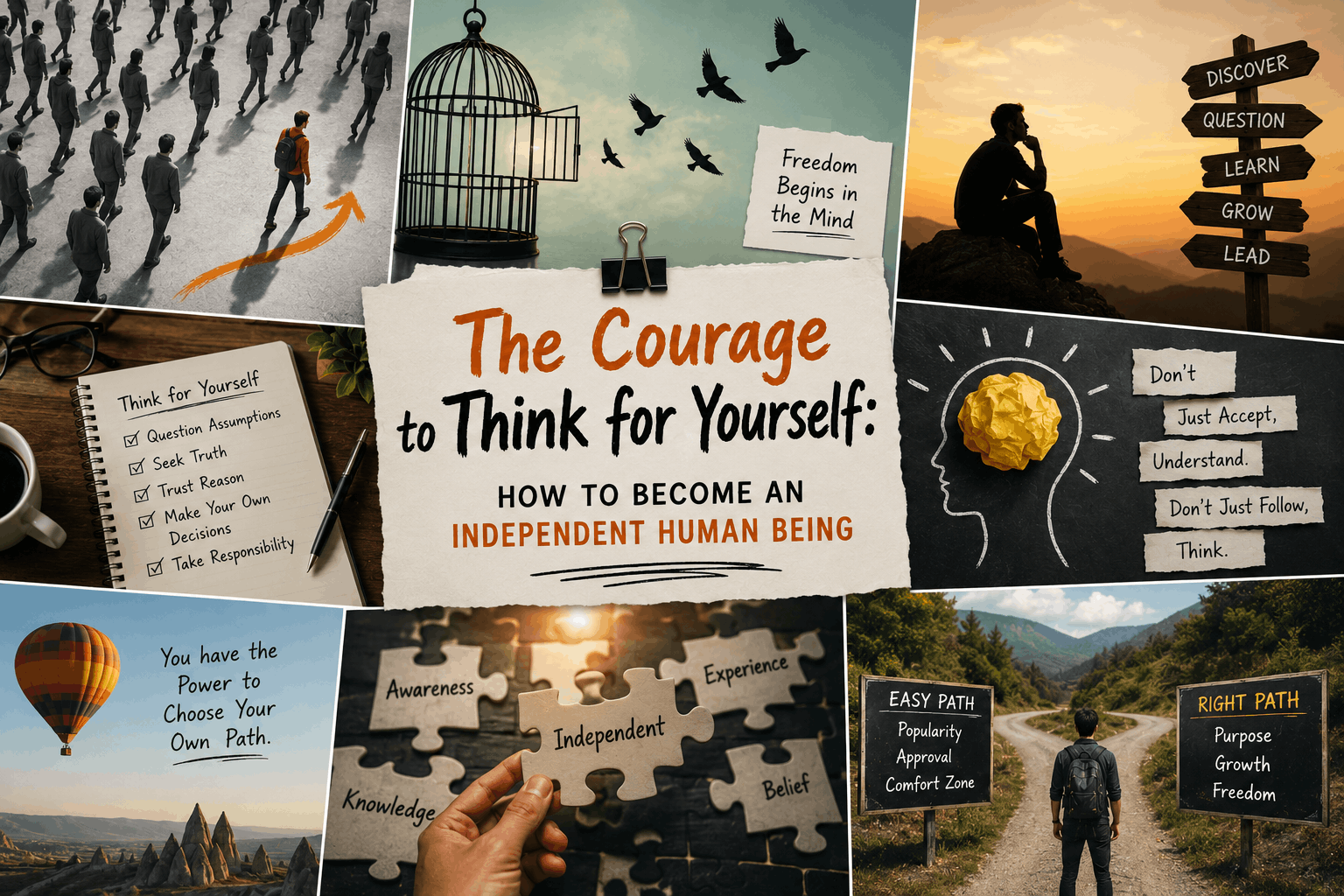
What Does It Mean to Think for Yourself?
Thinking for yourself does not mean refusing to listen to other people.
It doesn’t mean assuming that you are smarter than everyone else.
And it certainly doesn’t mean disagreeing with everything.
Independent thinking means developing the ability to:
Question your assumptions
Examine information
Consider different perspectives
Recognize your own biases
Separate facts from opinions
Learn from other people’s experiences
Make conscious decisions
Change your mind when you discover better information
A person who thinks independently can listen carefully without automatically accepting everything they hear.
They can disagree without becoming hostile.
They can accept criticism without feeling personally attacked.
And they can admit:
“I don’t know.”
That may be one of the most powerful statements an independent person can make.
Why Is It So Easy to Let Other People Think for Us?
Human beings are social creatures.
We naturally look to other people for guidance.
When we were children, our parents told us what was safe and what was dangerous.
Teachers taught us what was important.
Communities taught us what was considered normal.
Religious traditions taught us how to understand God and morality.
Society taught us what success was supposed to look like.
None of this is necessarily bad.
In fact, much of human civilization depends on passing knowledge from one generation to another.
The problem begins when we stop examining what we have inherited.
A belief can become so familiar that we mistake familiarity for truth.
We may think:
“Everyone I know believes this, so it must be true.”
But popularity isn’t proof.
And tradition, while valuable, isn’t automatically proof either.
The Easy Path and the Courageous Path
The easiest thing in life is to let someone else do our thinking for us.
It’s easier to accept an opinion because someone we trust believes it.
It’s easier to follow the crowd than to stop and ask questions.
It’s easier to repeat what we have heard than to search for understanding ourselves.
It’s easier to say:
“That’s just the way things are.”
But personal growth often begins when we become willing to ask:
“Why?”
Why do I believe this?
Why do I behave this way?
Why do I consider this person trustworthy?
Why do I fear this idea?
Why do I reject that perspective?
Why have I never questioned this belief before?
These questions can open doors.
Independent Thinking Doesn’t Mean Rejecting Wisdom
There is an important distinction between thinking for yourself and thinking that you know everything yourself.
Nobody does.
Human beings have accumulated thousands of years of knowledge.
Scientists, philosophers, historians, religious teachers, artists, writers, spiritual seekers, and ordinary people have all contributed to our understanding of the world.
We should learn from them.
Independent thinking doesn’t say:
“I don’t need anyone.”
It says:
“I will listen carefully and decide consciously.”
You can respect a teacher without agreeing with everything they say.
You can love your religious tradition while exploring difficult questions.
You can respect your parents while developing your own understanding.
You can learn from a philosopher without adopting their entire worldview.
You can listen to an expert while still asking how they reached their conclusion.
That’s intellectual independence.
Ask: “Why Do I Believe This?”
One of the simplest practices for developing independent thinking is also one of the most powerful:
Ask why.
Choose one belief that you hold strongly.
It could be about:
God
Religion
Politics
Relationships
Money
Success
Happiness
Society
Spirituality
Human nature
Then ask:
Why do I believe this?
Don’t immediately defend the belief.
Don’t immediately attack it.
Simply investigate it.
Where did it come from?
Who taught it to you?
What experiences shaped it?
What evidence supports it?
Have you ever seriously considered another perspective?
And perhaps most importantly:
Would you still believe it if you had grown up somewhere completely different?
The Influence of Culture
Culture can have an enormous influence on our worldview.
Imagine two children born in completely different parts of the world.
They may grow up speaking different languages.
They may have different foods, traditions, religions, customs, and ideas about family.
They may learn completely different stories about history.
They may develop different ideas about what constitutes a successful life.
Neither child necessarily chose these influences.
They inherited them.
This doesn’t mean that everything they learned is wrong.
It means that all of us should recognize how much of our worldview was shaped before we were old enough to question it.
Understanding this can make us more curious about other cultures rather than automatically judging them.
What About Religion and Spirituality?
This question becomes especially important when we talk about spirituality.
Many people inherit their religious beliefs from their families.
They may grow up learning about God, prayer, heaven, morality, sin, salvation, reincarnation, or other spiritual concepts.
For some people, these beliefs become deeply meaningful.
For others, questions eventually arise.
Is this really what I believe?
What do other traditions teach?
Why do different religions describe God differently?
Can different traditions contain pieces of wisdom?
What can I actually know about God?
Asking these questions does not automatically mean abandoning faith.
For some people, questioning actually leads to a deeper and more personal relationship with spirituality.
Faith Can Survive Questions
A belief that cannot tolerate a question may deserve examination.
This doesn’t mean every question has an easy answer.
Some questions may remain mysteries.
But a healthy spiritual journey can make room for uncertainty.
You can believe in God while admitting that you don’t understand everything about God.
You can have faith while recognizing that human beings can misunderstand religious teachings.
You can value your tradition while learning about other traditions.
You can pray while thinking critically.
You can remain spiritually open without accepting every claim you encounter.
The goal isn’t to destroy faith.
The goal is to make your relationship with faith more conscious.
Beware of Confirmation Bias
One of the biggest obstacles to independent thinking is our tendency to look for information that confirms what we already believe.
Suppose you strongly believe something.
You may naturally search for articles supporting your position.
You may follow people who agree with you.
You may dismiss opposing arguments without really considering them.
This is sometimes called confirmation bias.
The solution isn’t to believe the opposite of everything you already believe.
Instead, try asking:
“What is the strongest argument against my position?”
Then genuinely listen to it.
You may discover that your original belief was stronger than you thought.
Or you may discover that it needs to change.
Either outcome can be valuable.
Don’t Confuse Confidence With Truth
A person can be extremely confident and completely wrong.
Confidence is not evidence.
Someone may speak passionately.
They may have thousands of followers.
They may be famous.
They may have impressive credentials.
They may sound certain.
None of these things automatically makes their claim true.
Instead, ask:
What is the evidence?
How reliable is the source?
Can the claim be independently verified?
Are there reasonable alternative explanations?
Is the person presenting facts, opinions, or interpretations?
These questions are especially important in the age of social media, where information can spread to millions of people before anyone has carefully examined it.
The Courage to Say “I Don’t Know”
There is tremendous pressure to have an answer.
People often feel that saying “I don’t know” makes them appear weak.
But intellectual humility can be a strength.
Consider how many questions remain unanswered about the universe, consciousness, human existence, and spirituality.
We have learned extraordinary things.
But we still don’t know everything.
Being comfortable with uncertainty allows us to keep learning.
Instead of pretending to have all the answers, we can say:
“I don’t know yet.”
That final word matters.
Yet.
It leaves the door open.
Listen Without Automatically Agreeing
One of the best ways to develop independent thinking is to learn how to listen.
When someone expresses an opinion you disagree with, try asking:
“Why do they believe this?”
Not:
“How can I prove them wrong?”
Understanding someone isn’t the same as agreeing with them.
You can understand a religious belief without adopting it.
You can understand a political position without supporting it.
You can understand another person’s worldview without abandoning your own.
The ability to understand perspectives you don’t share is a form of intellectual strength.
A Simple Practice for Becoming More Independent
Try this exercise once a week.
Choose one belief you hold strongly.
Write it down.
Then answer these questions:
1. What exactly do I believe?
2. Where did this belief come from?
Family?
Religion?
Culture?
Personal experience?
Education?
3. What evidence supports it?
List the strongest evidence you know.
4. What evidence challenges it?
5. What would change my mind?
This is one of the most important questions.
If the answer is “nothing,” ask yourself why.
6. What do people who disagree with me believe?
Try to understand their strongest argument.
7. Do I still believe what I believed before?
Maybe yes.
Maybe no.
Maybe you’re less certain.
All three outcomes can represent growth.
Independence Requires Responsibility
Thinking independently doesn’t mean that every decision should be based only on personal feelings.
Sometimes experts know more than we do.
A doctor may know more about medicine.
An engineer may know more about structural safety.
A scientist may know more about a particular field.
A historian may know more about a historical period.
Listening to expertise isn’t weakness.
The important question is whether we understand why we trust an expert.
Independent thinking means knowing when to seek expertise, how to evaluate sources, and when our own knowledge isn’t sufficient.
The Difference Between Independent Thinking and Rebellion
Some people confuse independence with rebellion.
They think:
“If everyone says yes, I’ll say no.”
But that’s still allowing the crowd to control you.
You’re simply doing the opposite.
If everyone believes something and you independently conclude that it’s true, agreeing with them doesn’t make you less independent.
If everyone rejects something and you independently conclude that it’s valuable, accepting it doesn’t make you less independent.
Independence isn’t about being different.
It’s about being conscious.
True Freedom Begins in the Mind
We often think of freedom as being able to travel wherever we want, choose our careers, express our opinions, or make our own decisions.
But there is another kind of freedom:
Freedom from unconscious thinking.
When we automatically accept every belief handed to us, we may be physically free but mentally dependent.
When we become aware of our assumptions, we gain another kind of freedom.
We can choose what we believe.
We can choose what we value.
We can choose how we respond.
We can choose what kind of person we want to become.
That is a deeper form of independence.
Thinking for Yourself Can Change Your Life
Once you begin examining your beliefs, you may discover that some things you’ve always believed still make sense.
Others may change.
You may discover that you don’t actually want the life you thought you wanted.
You may realize that success means something different to you.
You may question old ideas about relationships, money, religion, spirituality, or happiness.
You may discover that some of your fears were inherited rather than chosen.
And you may begin making decisions based less on:
“What will everyone think?”
and more on:
“What do I genuinely believe is right?”
That can be a profound transformation.
The Spiritual Side of Independent Thinking
At its deepest level, thinking for yourself can become part of a spiritual awakening.
Spiritual awakening isn’t necessarily about suddenly receiving all the answers.
Sometimes it begins when we become aware of how much of our lives has been shaped by unconscious beliefs.
We start observing ourselves.
We start questioning.
We start listening.
We start becoming more aware.
And eventually, we begin asking the biggest questions:
Who am I?
Why am I here?
What is God?
What is truth?
What does it mean to live a good life?
What happens after death?
These questions have been at the heart of human spirituality for thousands of years.
You Don’t Have to Think Alone
Independent thinking doesn’t mean isolating yourself.
In fact, conversation can make thinking stronger.
Talk to people who see the world differently.
Read books from different traditions.
Listen to people from different cultures.
Study history.
Explore philosophy.
Learn about religion.
Meditate.
Spend time in nature.
Ask difficult questions.
The goal isn’t to eliminate outside influence.
That is impossible.
The goal is to become conscious of those influences and decide what deserves a place in your own understanding.
The Awakening of the Independent Human Being
Perhaps humanity’s greatest challenge isn’t a lack of information.
We have more information available to us than any generation in history.
The challenge is learning how to think carefully about it.
To slow down.
To question.
To listen.
To examine.
To recognize our biases.
To admit when we don’t know.
And to choose our beliefs consciously.
A truly independent human being isn’t someone who rejects everyone else.
It is someone who can listen to everyone without surrendering their own ability to think.
They can learn without becoming dependent.
They can question without becoming cynical.
They can have faith without becoming blind.
They can disagree without becoming hateful.
And they can change their minds without feeling ashamed.
The GodsYou Perspective
At GodsYou, the search for truth is part of the larger human search for meaning, spirituality, and God.
Different cultures and traditions have offered different answers to life’s biggest questions.
Exploring them doesn’t require us to immediately accept or reject them.
It requires curiosity.
It requires humility.
And it requires the courage to think.
Maybe becoming spiritually awake isn’t about finding someone who can tell you exactly what to believe.
Maybe it begins when you become willing to ask:
“What do I actually believe and why?”
That question can be the beginning of a remarkable journey.