

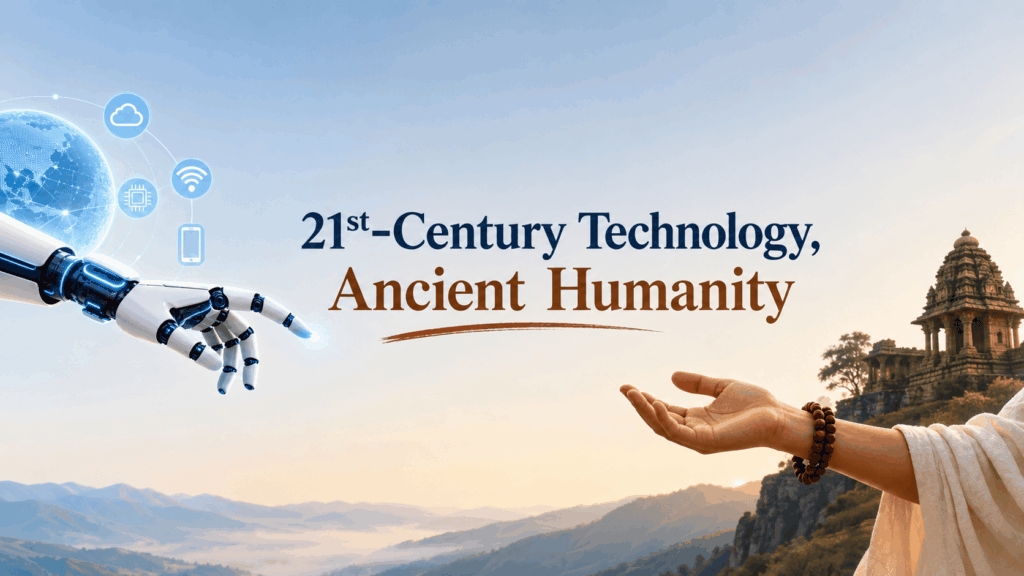
21st-Century Technology, Ancient Humanity
Something happened at work recently that made me think about how far humanity has come.
And how far we haven’t.
A coworker and I were talking about earthquakes and the terrible suffering they can cause. She suggested that perhaps disasters like these happen because people have resisted the right kind of Christianity.
That thought stayed with me.
Not because I wanted to criticize her.
Because I suddenly realized how ancient the idea was.
Look around us.
We have electric cars.
We carry computers in our pockets that connect us instantly with almost anyone on Earth.
Artificial intelligence can talk with us, write with us, create images, analyze information and increasingly assist with decisions.
Doctors transplant hearts.
We send spacecraft billions of miles from Earth.
We can look through telescopes and see galaxies whose light began traveling toward us billions of years ago.
Human knowledge has exploded.
And yet an earthquake happens…
and somewhere, someone still says:
“God is angry with those people.”
That raises a disturbing question.
What if our technology has evolved much faster than we have?
The Smartphone and the Tribal Mind
For thousands of years, human beings tried to explain frightening things they couldn’t understand.
The crops failed. The gods must be angry.
Lightning struck. Someone must have offended the gods.
Disease arrived. Someone must have sinned.
An earthquake destroyed a village. The people must have done something wrong.
Today we understand tectonic plates, weather systems, bacteria, viruses and genetics.
But understanding the science doesn’t necessarily remove the ancient instinct.
Sometimes we simply give the instinct modern clothes.
The century changes.
The technology changes.
The words change.
But underneath remains:
My people are right.
Your people are wrong.
My beliefs are true.
Your suffering proves it.
We have changed the tools without necessarily changing the consciousness using them.
And perhaps that is one of humanity’s greatest challenges.
But There Is Another Side to This
There is another contradiction appearing in modern society that may be even more troubling.
At one end of society, we still have ancient superstition.
At the other end, among some of the most technologically powerful people in the world, we can encounter almost the opposite problem:
Not too much belief in humanity, but too little.
Technology can become the object of wonder.
Artificial intelligence becomes fascinating.
Efficiency becomes sacred.
Power becomes admirable.
Human beings become statistics.
Consumers.
Workers.
Voters.
Data points.
Obstacles.
And somewhere along the way, we risk forgetting the astonishing thing technology was supposed to serve in the first place:
Life.
A machine can calculate faster than you.
It may eventually reason better than you in many areas.
It doesn’t get tired.
It doesn’t need lunch.
It doesn’t grow old.
It may eventually perform enormous numbers of jobs better than human beings can.
But since when did usefulness determine the value of a life?
A newborn baby contributes almost nothing economically.
An elderly person with dementia may produce nothing.
A severely disabled person may never invent anything, run a company or increase a nation’s GDP.
Are their lives therefore worth less?
Of course not.
And that may be one of the most important questions humanity will face in the age of artificial intelligence.
Do we value human beings because of what they produce, or because they are human beings?
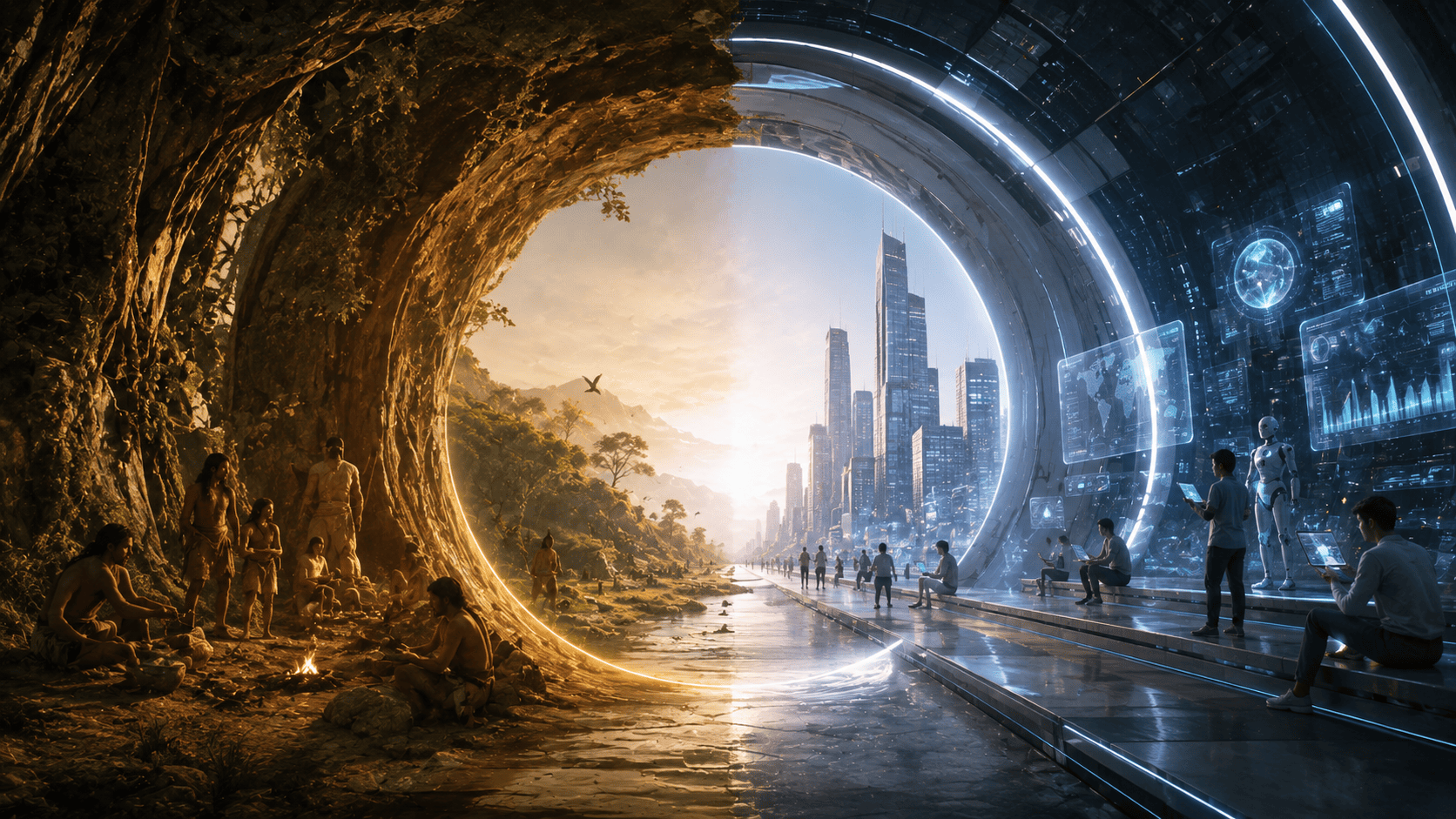
When Intelligence Becomes More Important Than Compassion
There are extraordinarily powerful people today who spend enormous amounts of money and energy thinking about artificial intelligence, human enhancement and what might come after ordinary biological humanity.
Peter Thiel, for example, has publicly wrestled with questions about AI, technological progress and humanity’s future.
The problem isn’t that people are asking these questions.
We desperately need people asking them.
The danger comes if technological advancement becomes the goal instead of human flourishing.
What good is a machine that can solve almost any intellectual problem if we become less capable of caring about one another?
What good is longer life if we don’t know what makes life meaningful?
What good is extraordinary intelligence if we use it to build more sophisticated ways of fighting?
What good is technological freedom if people become psychologically incapable of living without the technology?
Technology can give us more power.
It cannot automatically give us wisdom.
And perhaps that distinction matters more than ever.
We Have Become Extremely Good at Asking “Can We?”
Human history is full of remarkable achievements.
We learned how to fly.
We split the atom.
We mapped the human genome.
We built global communication networks.
We developed artificial intelligence.
We can manipulate matter at extraordinary scales.
But there is another question we don’t always ask.
Not:
“Can we?”
But:
“Should we?”
Can we build it? Yes.
Should we? That’s harder.
Can we collect enormous amounts of personal information? Probably.
Should we?
Can AI replace a particular human task? Perhaps.
Should it?
Can we genetically modify something? Possibly.
Should we?
Can we create systems capable of making decisions humans don’t fully understand? Potentially.
Should we?
Technology is very good at answering questions about possibility.
Wisdom asks questions about consequences.
Ancient Humanity in a Modern Machine
Perhaps this is the strange irony of the 21st century.
We are surrounded by futuristic technology while carrying ancient psychological patterns inside us.
We still want status.
We still fear outsiders.
We still form tribes.
We still become angry when someone challenges our beliefs.
We still want someone to blame when something goes wrong.
We still confuse confidence with knowledge.
We still seek leaders who tell us that our group is special and someone else is the problem.
We still want simple answers to complicated questions.
And now we have something our ancestors never had:
the ability to spread those instincts around the entire planet in seconds.
An angry thought once stayed inside a village. Now it can reach millions.
A rumor once traveled by horse. Now it travels at the speed of light.
A lie once required someone to repeat it. Now algorithms can amplify it.
The technology is new. The psychology isn’t.
Artificial Intelligence Doesn’t Make Us Wise
This may be one of the biggest misunderstandings of our technological age.
We often assume that more information will make humanity wiser.
But information and wisdom are not the same thing.
You can know everything about nuclear physics and still use that knowledge destructively.
You can know everything about human psychology and manipulate people.
You can understand algorithms and use them to spread hatred.
You can have extraordinary intelligence and terrible judgment.
Wisdom asks a different question:
What should I do with what I know?
And that question cannot always be answered by more information.
It requires values.
It requires judgment.
It requires empathy.
It requires humility.
And perhaps it requires something we might call spirituality.
What Does Spirituality Have to Do With Technology?
At first, the two subjects may seem completely unrelated.
One involves artificial intelligence, computers, medicine and spacecraft.
The other involves God, consciousness, meditation, meaning and the inner life.
But perhaps they meet at exactly the same question:
What are we becoming?
Technology changes what human beings can do.
Spirituality asks what human beings should become.
Technology can extend our reach.
Spirituality can ask where we should direct that reach.
Technology can increase our power.
Spirituality can ask whether we are wise enough to use that power.
Technology can connect billions of people.
Spirituality can ask whether we actually care about the people we’re connected to.
Perhaps we need both.
The Old Question: What Makes a Human Being Valuable?
This question is becoming increasingly important.
If intelligence determines value, what happens when machines become more intelligent than humans?
If productivity determines value, what happens when machines can perform most economically useful tasks?
If speed determines value, what happens when machines are faster?
If memory determines value, what happens when machines can remember almost everything?
If mathematical ability determines value, what happens when computers outperform us?
If creativity determines value, what happens when AI can generate music, writing, art and ideas?
Perhaps we need to discover that human worth was never based solely on these abilities.
Maybe human value exists deeper than performance.
A child doesn’t have to earn the right to exist.
A person doesn’t have to produce something extraordinary to deserve dignity.
An elderly person doesn’t become less human because their productivity declines.
A disabled person doesn’t become less valuable because they require assistance.
A poor person isn’t less important than a wealthy person.
If that is true, then perhaps humanity needs a philosophy of human dignity strong enough to survive the age of artificial intelligence.
Could Technology Actually Help Us Become More Human?
There is another possibility.
Technology itself isn’t necessarily the enemy.
A tool can be used badly or beautifully.
The internet can spread hatred. It can also connect lonely people.
Artificial intelligence can be used for manipulation. It can also help people learn.
Social media can create division. It can also reconnect families separated by distance.
Medical technology can become commercialized. It can also save lives.
The question may not be:
“Is technology good or bad?”
The better question might be:
“What kind of human beings are using it?”
A compassionate person can use technology compassionately.
A cruel person can use technology cruelly.
A wise society can build technology around human wellbeing.
A fearful society can build it around control.
Perhaps the technology reveals us.
Maybe Our Greatest Problem Isn’t Intelligence
We often worry about whether artificial intelligence will become smarter than humans.
That is a legitimate question.
But perhaps there is another question that deserves equal attention.
What happens if human intelligence grows faster than human wisdom?
We already possess extraordinary power.
We can alter ecosystems.
We can create weapons capable of destroying cities.
We can manipulate information on a global scale.
We can influence millions of people through technology.
We can modify biological systems.
And we are now building increasingly powerful artificial intelligence.
Perhaps the real challenge isn’t simply creating smarter machines.
Perhaps it is creating wiser human beings.
The Spiritual Question Behind the Technological Revolution
Underneath all of this is an ancient question:
What is a human being?
Are we simply biological machines?
Are we conscious organisms created through evolution?
Are we souls?
Are we spiritual beings having a temporary physical experience?
Are we something we don’t yet understand?
Different religions and philosophies answer these questions differently.
Science can investigate many aspects of human biology, cognition and behavior.
But questions about ultimate meaning, consciousness, God and purpose remain deeply contested.
Perhaps that is why spirituality still matters in a technological civilization.
The more powerful our tools become, the more important our questions become.
We Don’t Need to Choose Between Science and Spirituality
This doesn’t mean rejecting science.
Quite the opposite.
Science has given humanity extraordinary knowledge about the natural world.
We should value evidence.
We should respect scientific discovery.
We should be willing to change our beliefs when reliable evidence shows that we were wrong.
But science and spirituality often ask somewhat different kinds of questions.
Science can investigate: How does an earthquake happen?
Spirituality may ask: How should we respond when one happens?
Science can investigate: How does the brain function?
Philosophy and spirituality may ask: What is consciousness?
Science can develop powerful technologies.
Human beings must still ask: How should we use them?
These questions don’t necessarily have to compete.
They can exist alongside one another.
Perhaps Humanity’s Next Evolution Is Consciousness
We have evolved technologically at an astonishing speed.
But perhaps the next great challenge is internal.
Can we become less tribal?
Can we become more compassionate?
Can we disagree without hating each other?
Can we question our own beliefs?
Can we recognize when we are wrong?
Can we use enormous power without becoming intoxicated by it?
Can we create technology without forgetting the people it is supposed to serve?
Can we become intelligent enough to know when intelligence isn’t enough?
These may be spiritual questions.
And they may also be survival questions.
The Future May Depend on an Ancient Idea
There is an idea found in many spiritual traditions:
Know yourself.
It sounds simple.
But perhaps it is one of the hardest things a human being can do.
Know your fears.
Know your desires.
Know your prejudices.
Know your attachments.
Know the stories you tell yourself.
Know why you believe what you believe.
Know when you are angry.
Know when you are afraid.
Know when you are following the crowd.
Know when you want to be right more than you want to know the truth.
Because if we don’t understand ourselves, technology doesn’t necessarily make us better.
It may simply make us more powerful versions of who we already are.
A fearful human with powerful technology can create enormous fear.
A greedy human with powerful technology can create enormous inequality.
A hateful human with powerful technology can spread hatred farther than ever before.
But a compassionate human with powerful technology might be able to help millions.
The tool matters.
But the person holding the tool matters too.
So How Far Have We Really Come?
We can travel into space.
We can communicate instantly across oceans.
We can create machines that can hold conversations with us.
We can replace organs.
We can decode DNA.
We can see farther into the universe than any generation before us.
But can we forgive?
Can we listen?
Can we disagree peacefully?
Can we care about someone from another culture?
Can we see another person’s suffering without immediately looking for someone to blame?
Can we admit:
“I don’t know.”
Perhaps these are better measures of progress than technology alone.
Maybe civilization isn’t truly advancing if our machines become more sophisticated while our hearts remain trapped in ancient tribal conflicts.
The Question GodsYou Wants to Explore
This is where technology brings us back to spirituality.
The question isn’t whether technology is good or bad.
The deeper question is:
What kind of human beings are we becoming?
And underneath that question are even bigger ones.
Who are we?
Why are we here?
What is consciousness?
What is spirituality?
Does God exist?
Who is God?
Does human life have a purpose?
What makes a human being valuable?
What happens when our technology becomes more powerful than our wisdom?
These aren’t questions that can necessarily be answered by buying a newer phone, building a faster computer, or creating a more intelligent machine.
They require reflection.
They require humility.
They require conversation.
They require us to look not only outward at the universe…
but inward at ourselves.
Perhaps the Real Awakening Hasn’t Happened Yet
Maybe humanity’s greatest technological achievement isn’t going to be artificial intelligence.
Maybe it won’t be quantum computing.
Maybe it won’t be space travel.
Maybe it will be something much less visible.
A humanity that finally learns how to use enormous power without losing compassion.
A humanity that can disagree without hatred.
A humanity that can embrace science without believing science answers every question.
A humanity that can explore spirituality without surrendering its ability to think critically.
A humanity that can build extraordinary machines while remembering that people are not machines.
A humanity that understands that knowledge is powerful…
but wisdom is necessary.
Perhaps that is the real next step.
Not simply becoming more intelligent.
Becoming more conscious.
And maybe that is where the ancient search for God, meaning, truth and spirituality meets the technology of the 21st century.
The tools may be new.
The questions are ancient.
And perhaps the most important question of all is still waiting for us:
What kind of human beings do we want to become?