


Different Religions. Different Answers.
But What Are People Actually Finding?
Look around.
Wars.
Political anger.
Money problems.
Loneliness.
Families divided.
People frightened about their health, their jobs, their children, and their future.
And then somebody tells us:
“You need inner peace.”
Wonderful.
Where exactly do we get that?
Ask a Christian and you may hear:
“I find my peace in Jesus.”
Ask a Muslim and you may hear:
“My peace comes through Allah.”
Ask a Hindu devotee and you may hear about Krishna, devotion, surrender, and learning to remain steady through life’s changing circumstances.
Ask a Buddhist and the answer will probably sound quite different: peace may come through understanding suffering, observing the mind, loosening craving and attachment, practicing compassion, and awakening.
These traditions are not interchangeable.
They make different claims about God, human beings, suffering, salvation, and reality.
But something fascinating happens.
People following very different paths can describe experiences that sound remarkably familiar:
“I don’t feel so alone.”
“I’m not as afraid.”
“I stopped trying to control everything.”
“My problems are still there, but they don’t control me the way they used to.”
So perhaps there is another question worth asking:
What Are They Actually Experiencing?
What Are They Actually Experiencing?
Christian scripture describes a peace connected with trust in God and Christ—a peace that can exist even in difficult circumstances.
The Qur’an describes hearts finding tranquility in the remembrance of Allah.
The Bhagavad Gita repeatedly explores equanimity: remaining internally steady through pleasure and pain, praise and criticism, success and disappointment.
Buddhist teachings approach the question differently, examining the relationship between craving, attachment, and suffering and developing awareness that allows us to relate differently to them.
Different explanations.
Different practices.
Different beliefs.
But perhaps there are human experiences worth examining underneath them.
1. They Stop Carrying the Universe by Themselves
Think about how exhausting ordinary life can become.
We try to control our health.
Our money.
Our relationships.
Other people’s opinions.
Our children’s futures.
Our careers.
Politics.
Tomorrow.
Eventually, the mind is trying to control things that no human being can completely control.
Many spiritual traditions, in very different ways, challenge that.
For a Christian or Muslim, it may mean trusting God with what cannot be controlled.
For a Hindu devotee, it may involve devotion and surrender while continuing to fulfill one’s responsibilities.
For a Buddhist, it may involve seeing our attachment to controlling outcomes and learning to release that attachment.
The theology is different.
But something can change inside the person:
“I still have responsibilities—but I don’t have to personally control the entire universe.”
That can be an enormous relief.
2. They Feel Part of Something Larger
One of the most frightening feelings a human being can have is:
“I’m alone in this.”
Spirituality can radically alter that perception.
For some, God is present.
For others, community is present.
For others, life itself becomes interconnected.
The frightened little world of me, my problems, my fears, my future becomes part of something larger.
The problems haven’t necessarily disappeared.
But the person experiencing them has changed.
That difference can be profound.
3. Suffering Acquires Meaning
Pain becomes especially difficult when it seems meaningless.
Why is this happening?
Why me?
What is the point?
Religion and spirituality don’t always remove suffering.
Often they do something else.
They give people a framework through which to understand it.
A Christian might see suffering through faith, love, redemption, and relationship with God.
A Muslim may understand hardship through faith, patience, trust, and submission to Allah.
Hindu traditions offer several ways of understanding duty, action, attachment, devotion, and life’s difficulties.
Buddhist teachings begin from the recognition that suffering is part of human existence and explore how craving, attachment, and our relationship to experience can contribute to suffering.
Again, these are not identical explanations.
But each offers people a way to ask a deeper question:
“How can I respond to suffering without allowing it to destroy me?”
4. They Learn That Thoughts Are Not Always Facts
The human mind can be incredibly convincing.
It tells us:
“Everyone is judging me.”
“Something terrible is going to happen.”
“I can’t handle this.”
“My life will never get better.”
“I have to solve everything right now.”
But a thought is not necessarily a fact.
Spiritual and contemplative traditions have developed different ways of relating to thoughts.
Prayer can create space between a person and their fears.
Meditation can help someone observe thoughts without immediately following every thought.
Reflection can reveal patterns that previously operated automatically.
The objective isn’t necessarily to stop thinking.
It is to become more aware of what the mind is doing.
Instead of:
“I am my fear.”
we may begin to recognize:
“I am experiencing fear.”
That small difference can create space.
5. They Stop Making Happiness Dependent on Everything Going Their Way
Imagine saying:
“I will be happy when everything goes exactly the way I want.”
That is an impossible assignment.
People change.
Plans fail.
Money comes and goes.
Bodies age.
Relationships evolve.
Jobs disappear.
Children grow up.
Unexpected events happen.
If happiness depends entirely on controlling circumstances, happiness will always be vulnerable.
Many spiritual traditions challenge this way of living.
This doesn’t mean that people should stop trying to improve their lives.
It means recognizing that external success and inner peace are not necessarily the same thing.
You can work toward a better future while learning to appreciate the life you are living today.
6. They Develop a Practice
Peace rarely comes simply because someone decides:
“I want to be peaceful.”
Most traditions involve practice.
Prayer
Meditation
Reflection
Reading
Community
Service
Gratitude
Silence
Devotion
Acts of compassion
The specific practice varies enormously.
But the principle is similar:
What we repeatedly practice can shape how we experience life.
You wouldn’t expect to become physically fit by exercising once.
Likewise, inner habits generally develop through repetition.
A few minutes of meditation today may not transform your entire life.
But practicing awareness regularly can gradually change your relationship with your thoughts, emotions, and circumstances.
7. They Spend Less Time Asking “Why Me?”
Difficult circumstances naturally make us ask:
“Why me?”
Sometimes that question is understandable.
But eventually, another question may become more useful:
“What can I do with what has happened?”
You may not have chosen the situation.
You may not be able to change the past.
But you may still have choices about how you respond.
Can you learn something?
Can you ask for help?
Can you forgive?
Can you set a boundary?
Can you serve someone else?
Can you become wiser?
Can you become more compassionate?
The question doesn’t erase suffering.
It changes the direction of attention.
8. They Discover the Power of Letting Go
Letting go doesn’t mean giving up.
It can mean releasing your demand that reality must be exactly the way you want it to be.
Sometimes we hold onto:
Anger
Resentment
Fear
Regret
Old relationships
Past mistakes
The need to be right
The need to control other people
Holding these things can become exhausting.
Letting go doesn’t mean saying that what happened was acceptable.
It means asking whether carrying the emotional weight forever is helping you.
Sometimes forgiveness is less about approving what happened and more about refusing to let the past control the rest of your life.
9. They Connect With Other People
Peace isn’t always something we find alone.
Human beings need connection.
A conversation with a trusted friend can change an entire day.
A spiritual community can remind someone that they aren’t alone.
Helping another person can shift attention away from our own worries.
Listening to someone else’s story can put our own problems into perspective.
This is one reason spiritual communities have existed throughout human history.
People don’t simply gather to discuss ideas.
They gather because human beings need one another.
10. They Discover That Peace and Action Can Exist Together
There is a misconception that a peaceful person is passive.
But peace doesn’t mean doing nothing.
A peaceful person can protest injustice.
They can defend someone.
They can leave an unhealthy relationship.
They can work hard.
They can raise children.
They can build a business.
They can fight for something they believe is right.
The difference may be that action doesn’t have to come entirely from fear and anger.
You can act strongly without allowing hatred to consume you.
You can disagree without dehumanizing someone.
You can pursue justice without losing compassion.
That may be a deeper form of peace.
Is There One Universal Path to Inner Peace?
This is where the question becomes particularly interesting.
If different religions describe peace differently, does that mean they are all talking about exactly the same thing?
Not necessarily.
Christianity, Islam, Hindu traditions, Buddhism, and other spiritual traditions have important differences.
They should not be reduced to one generic spirituality.
Their teachings about God, salvation, consciousness, human nature, and ultimate reality can be profoundly different.
At the same time, comparing traditions can reveal something about the human experience.
Across cultures, people have searched for ways to deal with:
Fear
Suffering
Death
Loneliness
Desire
Uncertainty
Guilt
Anger
Meaning
The search for God
Perhaps one reason spirituality remains important is that these questions never disappear.
What If You Don’t Follow a Religion?
You don’t necessarily have to identify with a particular religion to begin exploring inner peace.
Some people pray.
Some meditate.
Some spend time in nature.
Some read philosophy.
Some explore different religious traditions.
Some practice gratitude.
Some volunteer.
Some simply spend time becoming more aware of their thoughts and actions.
The important thing may be to approach the search honestly.
You don’t have to pretend to believe something you don’t believe.
You can begin with a question:
“What helps me live with greater awareness, compassion, courage, and meaning?”
That question alone can become the beginning of a spiritual journey.
How Can You Find Peace in a Crazy World?
Start small.
You don’t need to solve the world’s problems before you can experience one peaceful moment.
Try this:
Put the phone down.
Give yourself five minutes without news or social media.
Take a few slow breaths.
Don’t try to force your mind to become empty.
Simply notice your breathing.
Look around.
Notice where you are.
Notice sounds, light, temperature, and the physical world around you.
Ask yourself:
“What am I trying to control that I cannot control?”
Then ask:
“What can I actually do today?”
Focus on that.
Connect with another person.
Call someone you care about.
Listen.
Be present.
Do one good thing.
Help someone.
Give.
Encourage.
Forgive.
Listen.
Sometimes peace grows through action rather than thought.
Peace Is Not a Perfect Life
Perhaps the biggest misunderstanding about inner peace is that peaceful people have peaceful lives.
They don’t necessarily.
They still lose people.
They still experience financial difficulties.
They still become sick.
They still experience disappointment.
They still have difficult relationships.
They still worry about the future.
The difference may be what happens inside them when life becomes difficult.
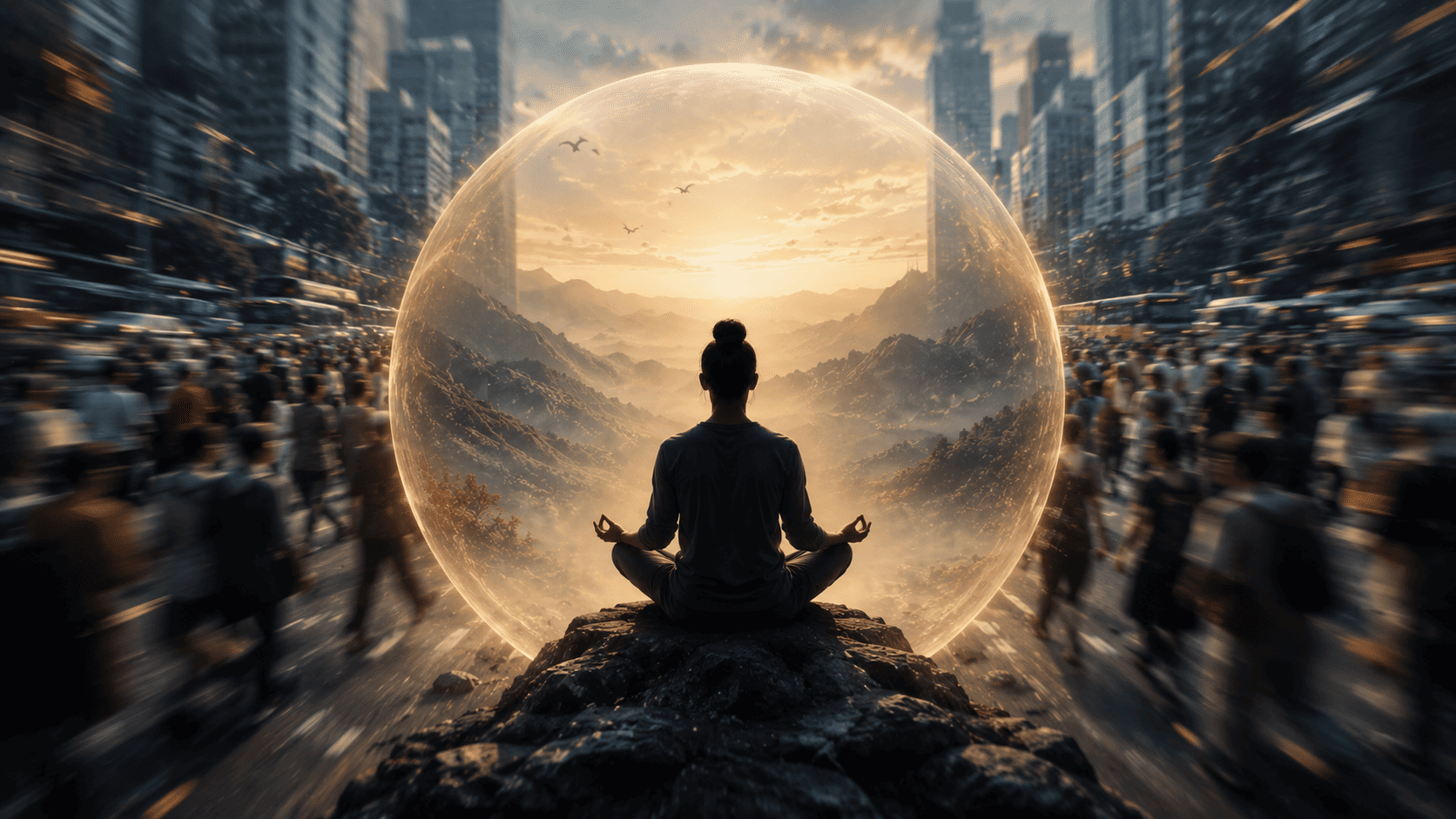
Peace isn’t necessarily the absence of storms.
Sometimes it is learning how to remain grounded while the storm is happening.
The Bigger Question: What Are We Really Searching For?
Maybe the search for peace is really part of a much larger human search.
We aren’t simply asking:
“How can I feel less stressed?”
We are also asking:
“What is this life about?”
“Who am I?”
“Why do I suffer?”
“Does God exist?”
“What happens after death?”
“How should I live?”
“What makes a life meaningful?”
These questions have been asked for thousands of years.
Different cultures have offered different answers.
And perhaps that is exactly why the conversation is worth continuing.
We don’t have to stop asking because someone else has already claimed to have the answer.
We can listen.
We can explore.
We can compare.
We can question.
We can reflect.
And we can continue searching.
The GodsYou Perspective
GodsYou is built around that human search.
The goal isn’t simply to tell people what they must believe.
It is to create a place where people can explore the world’s spiritual traditions, philosophies, beliefs, and biggest questions.
Christianity.
Islam.
Hindu traditions.
Buddhism.
Ancient wisdom.
Indigenous traditions.
Philosophy.
Meditation.
Spirituality.
And the countless ways human beings have tried to understand God, consciousness, existence, and meaning.
The answers may be different.
The traditions may disagree.
And that’s okay.
Perhaps the most important thing is that we continue searching honestly.
Because in a world that can sometimes feel increasingly divided, there may be enormous value in simply being willing to ask:
What can we learn from one another?
And perhaps, somewhere in that search, we discover not only different answers—but something deeper about ourselves.