

Could Uncertainty Be Part of the Spiritual Journey?
What if the biggest mistake we make in spirituality is believing we are supposed to have all the answers?
What if God exists—but we don’t completely understand God?
What if consciousness is far stranger than we realize?
What if there is something beyond this life—but we cannot prove exactly what it is?
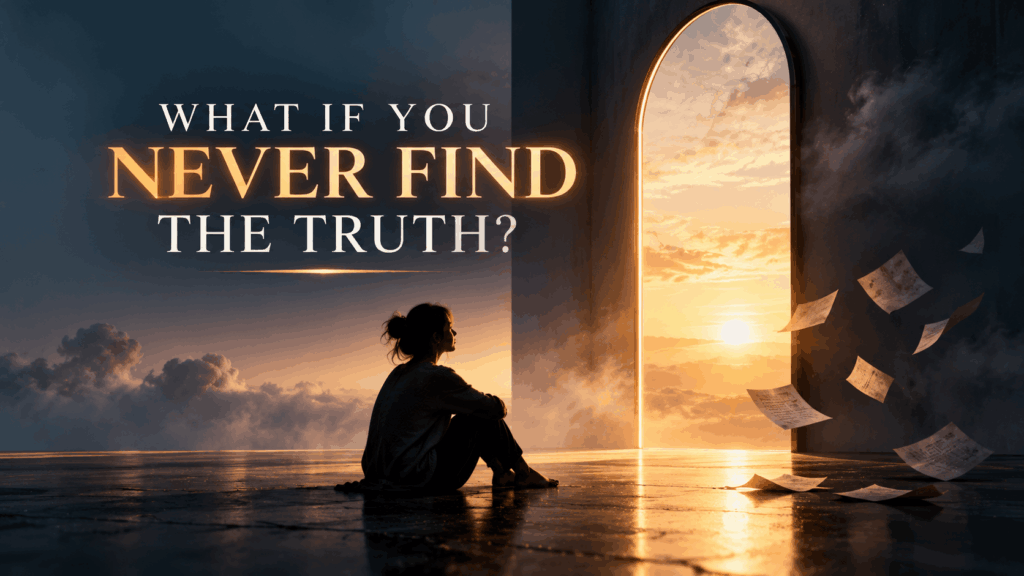
And what if we never discover the complete truth?
For many people, spirituality begins with questions.
But eventually, the questions can become overwhelming.
What is real?
Who is right?
Does God exist?
What happens when we die?
Is consciousness more than the brain?
The deeper you look, the more complicated things can become.
Perhaps that’s not a failure.
Perhaps that’s the beginning.
Everyone Seems to Have an Answer
Open the internet and you’ll find someone who is absolutely certain.
God is real.
God isn’t real.
There is an afterlife.
There is no afterlife.
Reincarnation is real.
Everything is consciousness.
Everything is energy.
Everything is simply biology.
Everyone seems to have an explanation.
But how many of us actually know?
This is one of the great tensions of spirituality.
We want certainty.
Reality may not give it to us.
What If Doubt Isn’t the Enemy?
Doubt is often treated as something dangerous.
But doubt can also protect us from believing something simply because someone told us to.
Questioning can make us more careful.
It can make us investigate.
It can make us distinguish between an experience and an interpretation.
It can make us comfortable saying:
“I don’t know.”
That sentence may sound weak.
Sometimes it requires enormous intellectual honesty.
You Don’t Have to Choose Between Science and Wonder
You can respect science without believing science has answered every question about existence.
You can be spiritual without rejecting evidence.
You can be skeptical without becoming cynical.
You can believe in God while admitting that your understanding of God is incomplete.
You can be an atheist and still be fascinated by consciousness, morality, existence, and the universe.
The categories don’t always have to be enemies.
Perhaps the real question is:
Can you remain curious without needing to immediately decide?
What If Your Beliefs Are Not the Same as Reality?
This is uncomfortable.
Our beliefs feel real because they exist inside our minds.
But feeling certain doesn’t make something objectively true.
We inherit beliefs from parents.
Communities influence us.
Books influence us.
Religious traditions influence us.
Social media influences us.
Personal experiences influence us.
Even our desire for something to be true can influence what we accept as evidence.
That doesn’t mean your spiritual experiences are meaningless.
It means they are worth examining carefully.
The Problem With Needing an Answer
Imagine you are standing beneath an enormous night sky.
You look upward and ask:
Why does anything exist at all?
There may be no immediate answer.
You could become frustrated.
Or you could simply stand there in wonder.
Sometimes the question itself changes you.
You become more humble.
More curious.
More aware of how little you know.
And perhaps that’s valuable.
What If God Is Bigger Than Our Definitions?
People often argue about God using definitions created by human language.
But if God exists as an ultimate reality, can a human definition completely contain that reality?
Different cultures have described the divine in radically different ways.
Some emphasize a personal God.
Some describe the divine through many forms.
Some speak of an ultimate consciousness.
Some approach the sacred through silence.
Others reject the idea of God entirely.
These differences don’t automatically prove that one perspective is correct.
But they do reveal something important:
Human beings have been asking questions about ultimate reality for a very long time.
You Can Keep Searching
You don’t have to decide everything today.
Read.
Question.
Meditate.
Study different traditions.
Talk to people who disagree with you.
Pay attention to your own experiences.
Learn to recognize the difference between:
“I believe this.”
and
“I know this.”
That distinction can transform your spiritual journey.
If you’ve ever questioned whether spirituality is possible without certainty, that’s a question worth exploring alongside DON’T BELIEVE IN GOD.
And if you’re wondering whether questioning your own thoughts can actually bring you closer to understanding yourself, explore WHAT IF YOUR MIND IS LYING TO YOU?.
Try the “I Don’t Know” Experiment
For one week, whenever you encounter a major spiritual question, resist the urge to immediately answer it.
Instead, write:
What do I believe?
Why do I believe it?
What evidence supports it?
What evidence challenges it?
What would change my mind?
You may discover something unexpected.
You may become more certain.
Or you may become less certain.
Both can be valuable.
Because the goal isn’t necessarily to collect beliefs.
The goal may be to become more honest about what you actually know.
Maybe Truth Is Bigger Than Certainty
Perhaps the spiritual journey isn’t a race toward absolute certainty.
Perhaps it is a willingness to keep looking.
To remain open without becoming gullible.
To remain skeptical without becoming closed.
To believe without pretending to know everything.
And to question without losing your sense of wonder.
Maybe the person who says “I don’t know, but I’m willing to keep searching” is not lost at all.
Maybe they are exactly where a seeker is supposed to be.
What if the search for truth matters almost as much as the truth itself?