
The Question Humanity Has Never Stopped Asking
One day, every human being faces the same mystery.
Death.
We can avoid talking about it.
We can stay busy.
We can distract ourselves.
We can pretend it isn’t coming.
But eventually, every life reaches a point where the question can no longer be avoided:
What happens next?
Is death the complete end of consciousness?
Is there something beyond this physical life?
Do we return in another form?
Do we meet God?
Or is the truth something we haven’t even imagined?
We don’t have a universally accepted answer.
And perhaps that is exactly why humanity has been asking this question for thousands of years.
Why Are We So Afraid of Death?
Part of our fear may come from uncertainty.
We know what life feels like.
We don’t know what death feels like from the perspective of the person who has died.
Religions have offered answers.
Philosophers have debated it.
Scientists study what happens to the brain and body as life ends.
But nobody can simply hand humanity one universally verified explanation of what happens after death.
So we fill the unknown with possibilities.
Heaven.
Reincarnation.
Nothingness.
Another dimension.
Union with God.
An eternal soul.
Or something beyond our current understanding.
What If Consciousness Continues?
One of the deepest questions surrounding death is consciousness.
Your body is physical.
Your brain is physical.
But your experience of being you feels very different from looking at an object in the world.
You experience thoughts.
Memories.
Love.
Fear.
Dreams.
Awareness.
So what happens to consciousness when the body dies?
Mainstream neuroscience investigates consciousness as closely related to brain function, while spiritual and philosophical traditions have proposed other possibilities, including the continuation of consciousness beyond physical death.
At present, the question remains unresolved.
That doesn’t prove an afterlife.
But it also means the question continues to matter.
What About Near-Death Experiences?
People who have been close to death sometimes report extraordinary experiences.
Some describe moving through darkness toward a bright light.
Some report a profound feeling of peace.
Others describe encounters with deceased relatives, spiritual figures, or a sense of leaving the body.
These experiences are often called near-death experiences, or NDEs.
They are real experiences reported by people, but their ultimate explanation remains debated.
Researchers have proposed neurological, psychological, and physiological explanations for aspects of NDEs.
Others interpret them spiritually.
The important point is this:
A powerful experience is not automatically proof of one particular explanation.
We can take people’s experiences seriously while remaining honest about what they do—and do not—prove.
What About Reincarnation?
The idea of reincarnation appears in several religious and philosophical traditions.
The basic concept is that some aspect of a person continues after death and is connected with another life.
Some researchers have investigated reports of children who claim memories of previous lives.
Such cases are fascinating and have been studied, but they do not provide universally accepted proof that reincarnation occurs.
That distinction matters.
We can remain curious without turning curiosity into certainty.
What If Death Changes Our Understanding of Life?
Here is another possibility.
Perhaps thinking about death isn’t only about discovering what happens afterward.
Perhaps it can change how we live right now.
Imagine knowing that your time here is limited.
Would you spend quite as much time worrying about what strangers think?
Would you hold onto every argument?
Would you postpone telling people you love them?
Would you continue living a life that doesn’t feel meaningful?
Death can remind us that time is not unlimited.
And that can make life more precious.
What If We Are Asking the Wrong Question?
Maybe we keep asking:
“What happens after I die?”
But perhaps another question is just as important:
“What am I doing while I am alive?”
Are you loving the people you care about?
Are you living according to your values?
Are you curious?
Are you helping anyone?
Are you experiencing life—or simply getting through it?
Perhaps the mystery of death can teach us something about the meaning of life.
Different Traditions, Different Answers
Humanity has never had only one understanding of death.
Christian traditions commonly include ideas of resurrection, judgment, and eternal life.
Islamic traditions include resurrection and an afterlife.
Hindu traditions include reincarnation and liberation.
Buddhist traditions describe rebirth while approaching the idea of a permanent, unchanging self differently.
Other cultures have their own understandings of ancestors, spirits, death, and continuation.
These traditions don’t all say the same thing.
And that diversity is worth exploring.
Instead of asking which belief we inherited, perhaps we can ask:
Why have humans across cultures continued to search for something beyond death?
Maybe We Don’t Need to Know Yet
Imagine that the answer is currently beyond human understanding.
Would that make the question meaningless?
Not necessarily.
There are many things humanity didn’t understand before we developed better ways of investigating them.
And there may be questions for which we never obtain complete answers.
Perhaps humility is appropriate.
We can investigate.
We can listen to people’s experiences.
We can study neuroscience.
We can explore philosophy.
We can learn from religious traditions.
And still say:
“I don’t know.”
There is something powerful about those three words.
Try Living With the Question
For one week, spend five minutes each day thinking about your mortality.
Not to frighten yourself.
Instead, ask:
If I knew my time was limited, what would I change?
Who would I call?
What would I stop worrying about?
What would I start doing?
Who would I forgive?
What would I finally say?
You don’t need to believe in an afterlife to benefit from the exercise.
The awareness of death can make us more aware of life.
What If Death Really Is the End?
This possibility deserves honesty too.
If death is the end of consciousness, that doesn’t necessarily make life meaningless.
It could make this life even more precious.
Every conversation matters because it happens once.
Every sunset matters because it doesn’t last.
Every relationship matters because time is limited.
Love matters because we don’t have forever.
And if there is something beyond death?
Then perhaps the way we live this life still matters.
Either way, we have today.
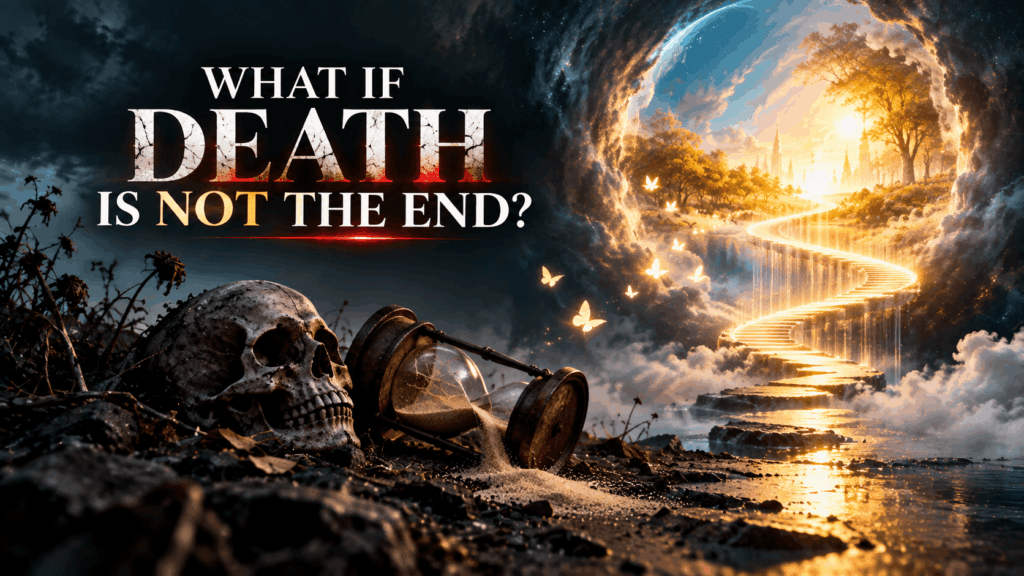
What If Death Is Not the End?
Maybe consciousness continues.
Maybe there is an afterlife.
Maybe reincarnation is real.
Maybe there is something beyond all of our current concepts.
Or maybe death is the complete end of individual consciousness.
We don’t need to pretend certainty where certainty doesn’t exist.
But we can remain open.
We can explore.
We can question.
And we can allow the mystery of death to make us more awake to the extraordinary fact that we are alive right now.
Perhaps the most important question isn’t:
“What happens when I die?”
Perhaps it is:
“What will I do with the life I have before I find out?”