
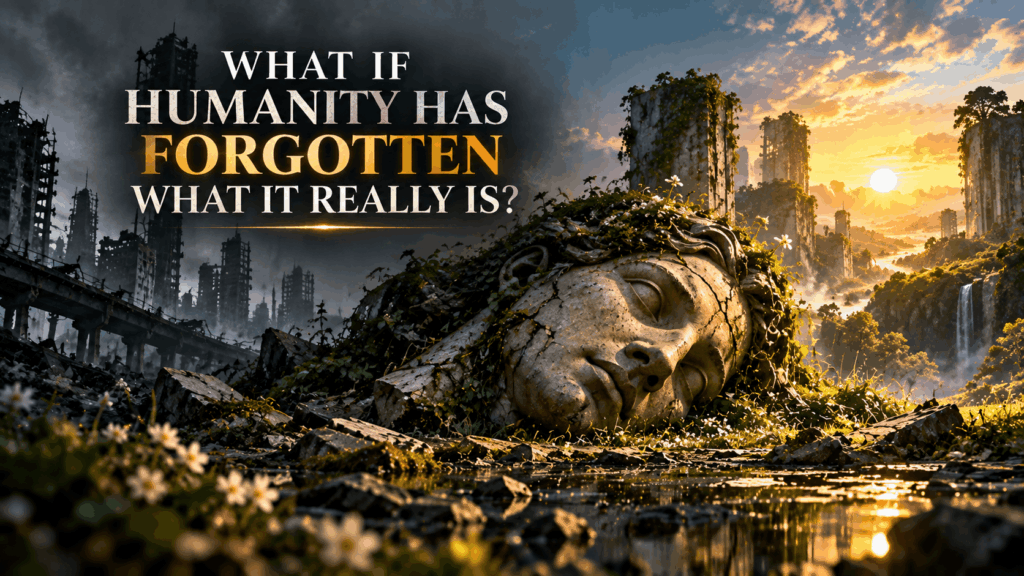
We Know More About the Universe Than Ever Before—So Why Do We Still Not Know Ourselves?
Humanity has spent thousands of years trying to understand the world.
We mapped the stars.
We crossed oceans.
We discovered electricity.
We walked on the Moon.
We built computers capable of processing extraordinary amounts of information.
And now we are developing artificial intelligence that can communicate, create, analyze, and learn in ways that would have seemed impossible to previous generations.
Yet one enormous mystery remains:
What exactly are we?
Are we simply biological organisms that evolved on one planet?
Are we consciousness experiencing the universe through temporary bodies?
Are we something between the two?
Or have we misunderstood ourselves completely?
We Know What the Body Is—But What About the Person?
We can study the human body in extraordinary detail.
We know about DNA, cells, organs, neural networks, hormones, and the biological processes that keep us alive.
But then something strange happens.
Somehow, from all of this physical complexity, there is an experience of being you.
You have memories.
You have thoughts.
You experience love.
You feel pain.
You imagine the future.
You remember the past.
You can look at your own existence and ask:
“Why am I here?”
The fact that we can ask that question is itself remarkable.
Are We Our Bodies?
Think about how much your body has changed throughout your life.
You were once a baby.
Then a child.
Then a teenager.
Now you are an adult.
Your body has continuously changed.
Your opinions have changed.
Your personality may have changed.
Your relationships have changed.
Yet you still have the feeling that there has been a continuous “me” experiencing all of it.
So what is that “me”?
Some spiritual traditions argue that there is a deeper self beyond the temporary body and personality.
Other philosophical and scientific perspectives understand personal identity and consciousness differently.
There is no universally accepted answer.
But perhaps the question deserves more attention than we give it.
What If We Have Reduced Ourselves to Too Little?
Modern society is very good at measuring things.
Income.
Productivity.
Intelligence.
Physical appearance.
Performance.
Followers.
Achievements.
We can turn almost anything into a number.
But can a number tell you the value of a human life?
Can a salary measure love?
Can a job title measure wisdom?
Can social-media followers measure compassion?
Can productivity measure the beauty of simply being alive?
Perhaps one of humanity’s problems is that we have become very good at measuring what people produce while becoming less interested in understanding what people are.
The Strange Human Need for Meaning
If humans were concerned only with survival, why do we spend so much time asking questions that have no immediate survival benefit?
Why do we create music?
Why do we paint?
Why do we write poetry?
Why do we build monuments?
Why do we bury our dead with rituals?
Why do we search for God?
Why do we wonder what happens after death?
Why do we look at the stars and ask whether we are alone?
Something about being human seems to push us beyond immediate survival.
We want to understand.
We want to connect.
We want our lives to mean something.
What If Consciousness Is the Bigger Mystery?
The universe outside us is enormous.
But perhaps the universe inside us is just as mysterious.
You can observe your thoughts.
You can notice emotions appearing and disappearing.
You can remember something from years ago.
You can imagine something that has never happened.
You can become aware that you are aware.
That last idea is especially strange.
Consciousness can turn its attention toward itself.
We don’t have a complete explanation for every aspect of conscious experience.
That doesn’t prove that consciousness is supernatural.
But it does remind us that the human story is not finished.
Maybe We Don’t Need a Secret Civilization
Ideas about ancient advanced civilizations, extraterrestrial intelligences, hidden knowledge, or lost human history can be fascinating.
But there is a danger in searching for an extraordinary explanation before examining what is directly in front of us.
Perhaps humanity hasn’t forgotten some secret cosmic civilization.
Perhaps we’ve forgotten something much more obvious:
how to pay attention.
We are constantly distracted.
Notifications.
News.
Entertainment.
Work.
Arguments.
Algorithms.
Advertising.
Our attention is one of the most valuable things we possess.
And we give much of it away.
What If We Have Forgotten How to Be Present?
Think about the last time you were completely present.
Not thinking about yesterday.
Not worrying about tomorrow.
Not checking your phone.
Not comparing yourself with somebody else.
Just experiencing what was happening.
Maybe you were walking through nature.
Talking to someone you love.
Listening to music.
Watching the ocean.
Looking at the stars.
For a brief moment, the endless story in your head becomes quieter.
And something changes.
You aren’t trying to become someone.
You are simply being.
Perhaps that experience is more important than we realize.
What If Humanity’s Problem Is Not Lack of Knowledge?
We have more information than any previous generation.
But information doesn’t automatically create wisdom.
We can know how to build powerful technology without knowing how to use it responsibly.
We can communicate instantly while still misunderstanding one another.
We can explore space while struggling to live peacefully on one planet.
We can know enormous amounts about the world while knowing surprisingly little about ourselves.
Maybe humanity doesn’t simply need more information.
Maybe we need greater awareness.
A Different Kind of Evolution
We’ve become accustomed to thinking about evolution as physical change.
But what if humanity’s next transformation is also psychological?
What if we become better at observing our thoughts?
Better at understanding our emotions?
Better at cooperating?
Better at seeing beyond tribal identities?
Better at recognizing the humanity of people who disagree with us?
Better at caring for the planet that sustains us?
That kind of evolution doesn’t require supernatural explanations.
It requires conscious choices.
Try This Experiment
Tonight, sit quietly for ten minutes.
Don’t pray unless you want to.
Don’t meditate unless you want to.
Just sit.
Notice your thoughts.
Then ask yourself:
“Who am I without my name?”
Then:
“Who am I without my job?”
Then:
“Who am I without my possessions?”
Then:
“Who am I without the opinions other people have about me?”
Don’t rush toward an answer.
The point isn’t to discover a secret identity.
The point is to notice how much of our idea of “self” is constructed from stories, labels, memories, and expectations.
Maybe We Are Still Discovering What Humanity Is
Perhaps the most exciting possibility isn’t that humanity once knew everything and forgot it.
Perhaps humanity has never completely known itself.
We are still discovering.
Still questioning.
Still evolving.
Still making mistakes.
Still looking upward.
Still looking inward.
Maybe the future of humanity depends not only on how much technology we develop, but on how deeply we understand ourselves.
Because if we become capable of extraordinary things without becoming wiser about who we are, our knowledge may outgrow our wisdom.
What If We Are Bigger Than the Story?
Maybe you are not simply your job.
Not your bank account.
Not your nationality.
Not your political identity.
Not your successes.
Not your failures.
Not even the story you’ve been telling yourself for years.
Those things may be parts of your life.
But perhaps they are not the whole of you.
And perhaps humanity itself is also more complicated than the story we currently tell about what we are.
We don’t have to invent an answer.
We don’t have to believe every extraordinary theory.
We can simply remain curious.
Because maybe the greatest discovery humanity has left to make isn’t another planet, another technology, or another scientific breakthrough.
Maybe it is this:
Understanding ourselves.
And perhaps the question isn’t whether humanity has forgotten what it really is.
Perhaps the question is:
Are we finally ready to find out?