

What Happens When We Die?
Human beings have been asking the same question for thousands of years:
What happens when we die?
Do we go to heaven? Do we enter another world? Do we meet God? Are we reborn into another life?
Or could there be something even stranger?
In recent years, a theory has become increasingly popular in spiritual and alternative circles. It suggests that after death, we may encounter a beautiful light, spiritual beings, deceased relatives, or other familiar images—but that these experiences might not always be what they appear to be.
Some believe we could be persuaded, manipulated, or even tricked into returning to Earth through reincarnation.
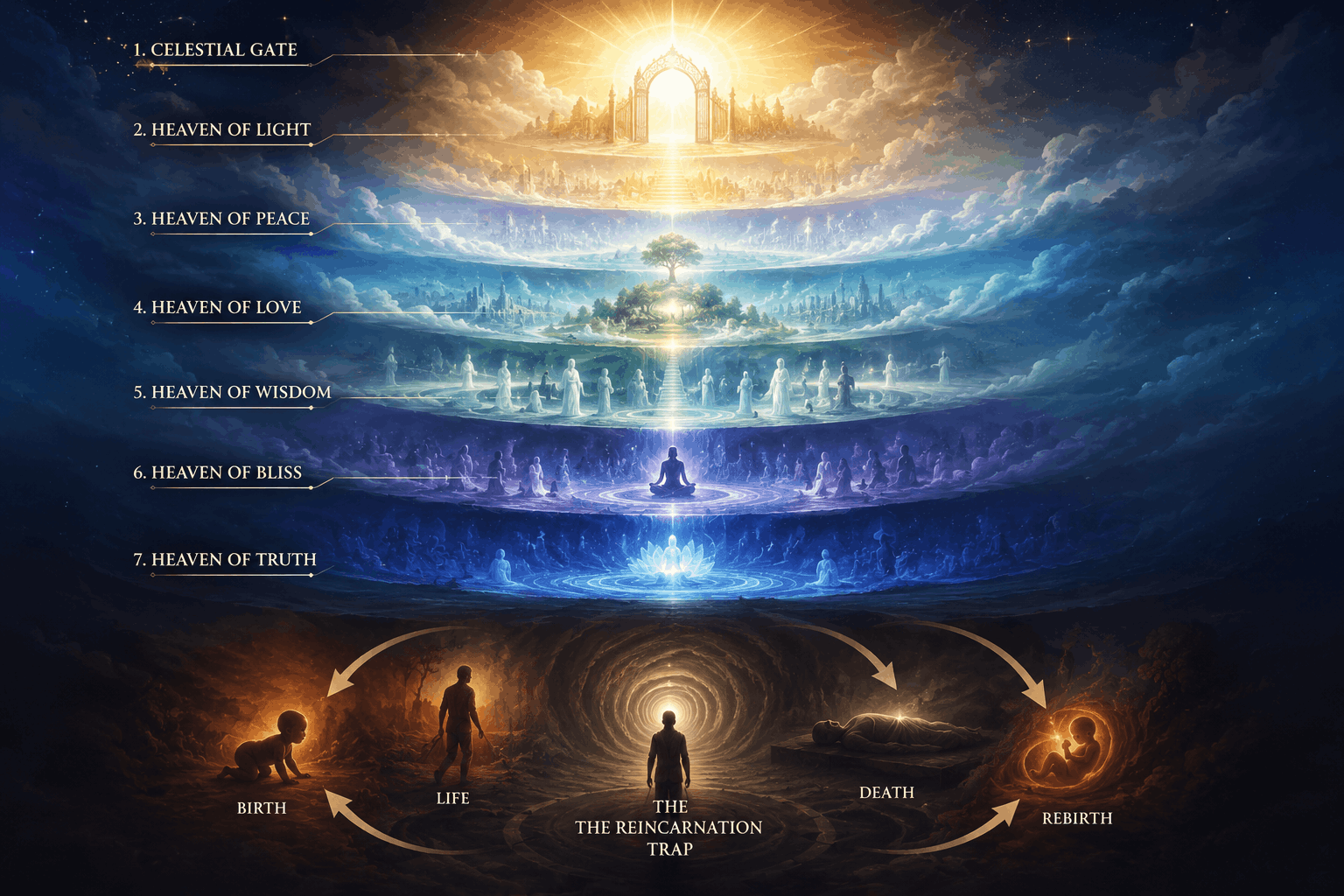
Others believe that after death the soul passes through a series of spiritual levels, sometimes described as seven heavens, before reaching higher states of consciousness.
These are fascinating ideas.
But before accepting or rejecting them, we should ask an important question:
What do we actually know, and what are simply beliefs, theories, traditions, or possibilities?
The honest answer is that nobody knows for certain.
And perhaps that uncertainty is what makes the subject so fascinating.
The Idea of Seven Heavens
The concept of multiple heavens is not new.
Different religious and mystical traditions have imagined the universe as having different levels or realms. Islamic tradition explicitly refers to seven heavens, while ideas about multiple heavens or spiritual realms have also appeared in Jewish, Christian, mystical, and esoteric traditions.
But these traditions do not all mean the same thing.
Sometimes a “heaven” was understood as an actual cosmic realm. Sometimes it represented a spiritual level. In other interpretations, multiple heavens can symbolize stages of closeness to God, spiritual development, or different dimensions of existence.
This distinction matters.
There is no universally accepted map of seven levels of heaven.
One tradition’s understanding of seven heavens may be completely different from another’s.
So when someone says, “There are seven levels of heaven,” the most accurate response isn’t necessarily:
“Yes, that has been scientifically proven.”
It is:
“Many religious and spiritual traditions have described multiple levels or realms of heavenly existence, sometimes using the number seven.”
Those are very different claims.
Why Does the Number Seven Appear So Often?
Seven has special significance in many religious and cultural traditions.
It appears repeatedly in sacred texts, mythology, symbolism, and spiritual teachings.
But the fact that different traditions use the number seven does not necessarily mean they are describing the same supernatural reality.
It may reflect the symbolic importance of the number within particular cultures and traditions.
This is an important distinction when exploring spiritual subjects:
A belief can be meaningful without being scientifically verified.
Spirituality often asks questions that science cannot currently answer, while science requires evidence that can be observed, tested, and independently evaluated.
Both perspectives can be explored without pretending that one automatically proves the other.
What About the Light?
Many people who report near-death experiences describe seeing a light.
Some describe traveling through darkness toward a brilliant light. Others describe overwhelming peace, love, deceased relatives, beautiful landscapes, or encounters with spiritual beings.
These experiences are real in the sense that people genuinely report having them.
But what causes them?
That is where certainty ends.
Modern research has proposed neurological and psychological explanations for near-death experiences, including changes in brain activity, oxygen levels, neurotransmitters, and the way the brain processes perception during extreme physiological stress. A recent review in Nature Reviews Neurology describes several neurobiological and psychological mechanisms being investigated.
At the same time, researchers and philosophers continue to debate whether these explanations account for every aspect of reported near-death experiences.
Some people interpret NDEs as evidence of consciousness continuing beyond the body.
Others interpret them as extraordinary experiences produced by a brain under extreme conditions.
At present, near-death experiences do not provide universally accepted scientific proof of an afterlife.
But they remain an important area of research and a deeply meaningful experience for the people who report them.
Why Do People See a Light Near Death?
There is no single proven explanation.
Researchers have proposed several possibilities.
These include:
Changes in brain activity during extreme physiological stress
Reduced oxygen availability
Changes in neurotransmitter activity
Alterations in perception and memory
Psychological responses to the possibility of death
Cultural and personal expectations
Experiences that science does not yet fully understand
A particularly important point is that experiencing something does not automatically tell us what caused it.
A person can have a profound experience without researchers yet knowing exactly how that experience was produced.
That uncertainty should not be confused with proof in either direction.
The “Reincarnation Trap” Theory
One of the more controversial modern spiritual ideas is sometimes called the reincarnation trap or soul trap theory.
According to different versions of this idea, after death a soul may encounter a light, spiritual guides, religious figures, or deceased loved ones.
The soul is then supposedly encouraged to review its life, feel guilt about mistakes, and agree to return to Earth in another body.
Some versions go much further, claiming that powerful beings deliberately keep souls trapped in a cycle of reincarnation.
It is an interesting theory.
It is also important to say clearly:
There is no scientific evidence proving that such a system exists.
No one has returned with a universally verifiable map of the afterlife.
No one has scientifically demonstrated that a light after death is a trap.
No one has proven that reincarnation is forced upon human souls.
The reincarnation-trap idea should therefore be treated as a modern spiritual or speculative theory, not as established fact.
But What About Reincarnation?
This is where the subject becomes even more interesting.
Reincarnation itself is not simply a modern internet theory.
Belief in reincarnation has existed for centuries and remains important in several religious and philosophical traditions.
In Hindu, Buddhist, Jain, and other traditions, concepts involving rebirth or cycles of existence have played major roles in understanding life, death, karma, and spiritual liberation.
But beliefs about reincarnation vary considerably.
Some traditions view rebirth as part of a cycle that continues until liberation.
Others understand the process very differently.
And modern researchers have also investigated unusual cases involving people—particularly children—who report memories that appear to relate to previous lives.
A peer-reviewed scoping review identified and analyzed academic studies of claimed past-life memories and described a body of observational research in this area.
That does not mean science has proven reincarnation.
It means that some unusual reports have been studied and remain an area of debate and investigation.
This distinction is important.
Researching a phenomenon is not the same as proving the phenomenon.
Near-Death Experiences and Reincarnation Are Not the Same Thing
These ideas are sometimes combined online, but they represent different questions.
A near-death experience (NDE) refers to an experience reported by someone who has been close to death or experienced a life-threatening medical event.
Reincarnation refers to the belief that some aspect of a person continues after death and becomes associated with another life.
The reincarnation-trap theory adds another layer by proposing that reincarnation is not simply natural or voluntary but part of a system that keeps souls returning.
These are three different concepts.
They should not automatically be treated as evidence for one another.
Could the Light Be a Gateway-or a Trap?
This is one of the most fascinating questions surrounding the subject.
If someone reports seeing an extraordinary light during a near-death experience, what does that light represent?
There are several possibilities people have proposed:
A Spiritual Gateway
Some interpret the light as an entrance into another spiritual realm or as an encounter with divine presence.
A Psychological or Neurological Experience
Others believe the experience could be produced by changes in the brain during extreme physical stress.
Something We Don’t Yet Understand
A third possibility is simply that our current understanding is incomplete.
We should be comfortable admitting that possibility.
Science has repeatedly demonstrated that the universe is more complicated than humans once imagined.
But “we don’t know” does not automatically mean “the most mysterious explanation must be true.”
It simply means:
We don’t know yet.
What Happens After Death? Science Has Limits
Science can study what happens to the body during dying.
Researchers can investigate brain activity, heart function, oxygen levels, perception, memory, and the experiences reported by people who survive life-threatening events.
But science cannot currently provide a universally accepted answer to the deeper spiritual question:
Does consciousness continue after biological death?
This remains one of the most difficult questions in philosophy, neuroscience, and spirituality.
Consciousness itself is still not completely understood.
That is why discussions about death often sit at the intersection of science, philosophy, religion, and personal experience.
Why People Are Drawn to These Ideas
The popularity of reincarnation-trap theories and afterlife discussions may reveal something deeper about human beings.
We want to understand death.
We want to know whether our loved ones continue to exist.
We want to know whether our lives have meaning.
And perhaps most importantly, we want to know whether death is truly the end.
These questions are not new.
Every generation asks them in its own language.
Ancient civilizations created elaborate stories about the afterlife.
Religions developed teachings about heaven, hell, judgment, rebirth, and liberation.
Modern people discuss near-death experiences, consciousness, simulation theories, soul traps, and reincarnation.
The vocabulary changes.
The fundamental question remains.
Fear vs. Curiosity
There is another important consideration.
Stories about a “reincarnation trap” can be fascinating, but they can also create unnecessary fear.
If someone becomes convinced that death itself is a trap and that spiritual beings are trying to manipulate them, the idea can become psychologically overwhelming.
There is currently no scientific evidence demonstrating that such a trap exists.
So rather than living in fear of an unproven scenario, it may be more useful to approach these ideas with curiosity and discernment.
Ask:
Where did this idea come from?
Is it a religious teaching or a modern theory?
What evidence supports it?
What evidence contradicts it?
Is someone presenting speculation as fact?
Are there alternative explanations?
What remains genuinely unknown?
These questions allow us to explore extraordinary possibilities without automatically believing every extraordinary claim.
What Do We Actually Know?
Let’s separate the ideas.
Question | What We Can Say |
Do people report near-death experiences? | Yes |
Do some people report seeing a light? | Yes |
Are NDEs scientifically understood completely? | No |
Do religions describe heavenly realms? | Yes |
Do some traditions describe seven heavens? | Yes |
Is there one universally accepted seven-heaven model? | No |
Is reincarnation part of several religious traditions? | Yes |
Have researchers studied claims of past-life memories? | Yes |
Has science conclusively proven reincarnation? | No |
Has science proven a reincarnation trap? | No |
Do we know exactly what happens after death? | No |
That final answer may be the most honest one.
We don’t know.
And that’s okay.
What Can Spirituality Teach Us About Death?
Spirituality doesn’t necessarily require certainty.
Sometimes the spiritual journey begins with asking questions that don’t have immediate answers.
Instead of asking only:
“What happens after I die?”
we can also ask:
“How do I want to live while I’m here?”
That question is within our reach.
We can practice:
Compassion
Gratitude
Meditation
Forgiveness
Self-awareness
Service
Presence
Love
Whatever ultimately happens after death, these practices can influence the life we are living now.
Perhaps the Most Important Question Is About Life
Thinking about death can change how we experience life.
It can remind us that time is limited.
It can encourage us to stop postponing meaningful experiences.
It can motivate us to repair relationships.
It can encourage forgiveness.
It can make an ordinary sunrise feel extraordinary.
Perhaps exploring death isn’t ultimately about becoming obsessed with what comes next.
Perhaps it is about learning to appreciate what is happening now.
A Balanced Way to Explore the Afterlife
If you’re fascinated by heaven, near-death experiences, reincarnation, or consciousness, you don’t have to choose between blind belief and complete rejection.
You can remain curious.
Read religious traditions.
Explore scientific research.
Listen to people’s experiences.
Study philosophy.
Practice meditation.
Question extraordinary claims.
And most importantly, recognize the difference between:
What is known.
What is believed.
What is possible.
And what remains unknown.
That distinction allows spirituality to remain an exploration rather than a collection of unquestioned conclusions.
How GodsYou Approaches Spiritual Questions
At GodsYou, we believe spiritual exploration should make you more curious, more aware, and more connected—not more afraid.
Questions about God, consciousness, death, reincarnation, spirituality, and awakening are deeply personal.
You don’t have to have all the answers before beginning your spiritual journey.
You can start by asking questions.
You can meditate.
You can explore different traditions.
You can learn from other people’s experiences.
And you can gradually develop your own understanding.
Our spiritual resources, online classes, courses, meditation practices, retreats, and educational articles are designed to support that process of exploration.
Final Thoughts: What Do We Really Know?
The seven heavens.
The light after death.
Near-death experiences.
Reincarnation.
The reincarnation trap.
These subjects sit at the fascinating boundary between spirituality, religion, philosophy, personal experience, and science.
Some aspects have been part of human spiritual traditions for thousands of years.
Others are relatively modern theories.
Some experiences have been studied scientifically.
Others remain speculative.
And some questions may remain unanswered for a very long time.
The most honest approach is neither to dismiss everything as impossible nor to accept every theory as fact.
Instead, stay curious.
Stay open.
And stay discerning.
Because perhaps the greatest part of the spiritual journey isn’t discovering one final answer to the mystery of death.
Perhaps it is learning how to live more consciously while we’re still here.
The mystery can remain a mystery—and still transform the way we live.