


Most of us believe that when we give to someone in need, the greatest blessing goes to the person receiving the gift.
We give food to someone who is hungry.
We donate money to a charity.
We provide clothing to a family going through a difficult time.
We volunteer our time.
We offer a helping hand.
But what if something else happens when we give?
What if the person receiving the gift isn’t the only one who benefits?
What if the giver receives a gift too?
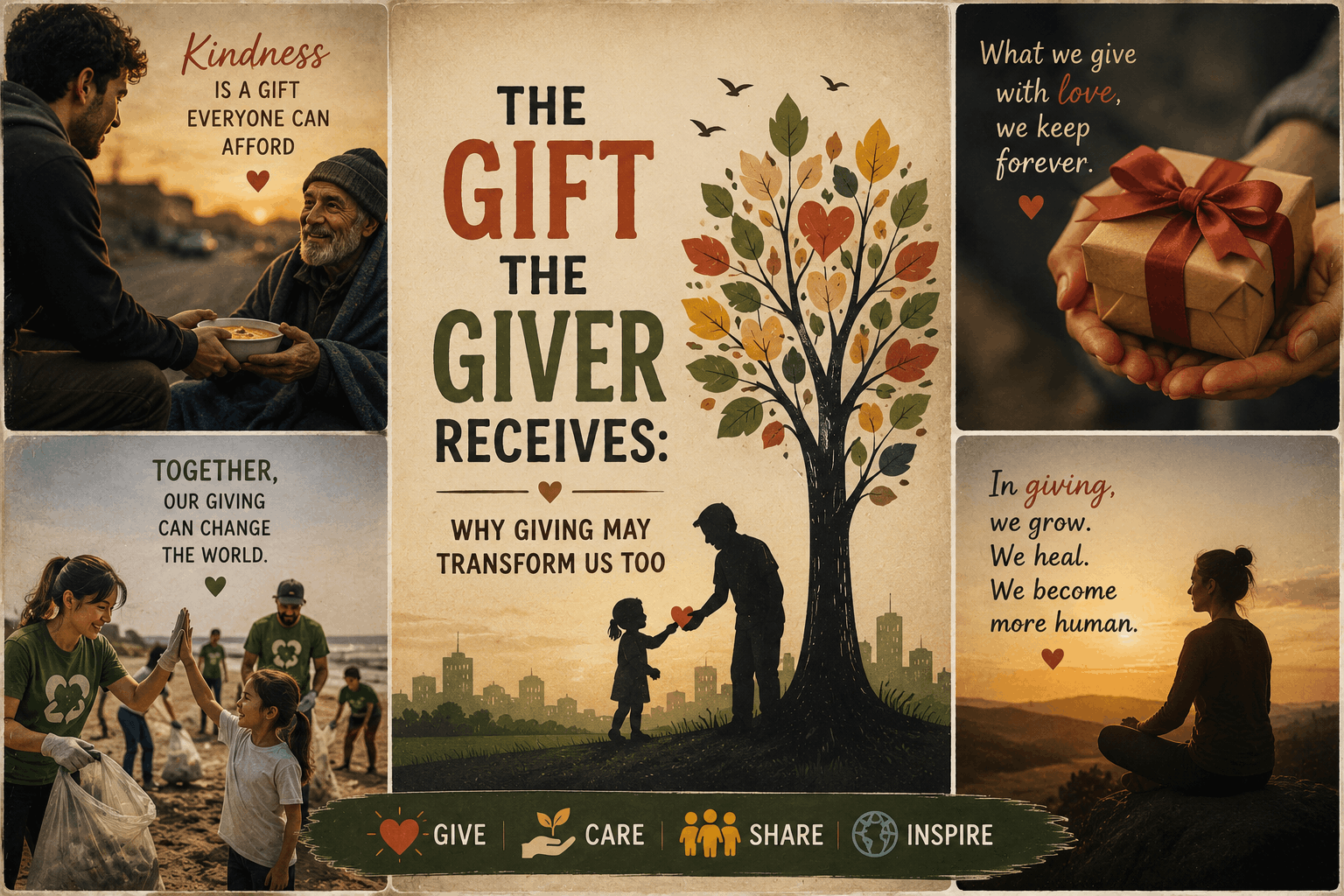
The Two Sides of Giving
Donating to trusted charities is important.
Charitable organizations provide food, medical care, disaster relief, education, housing support, and assistance to people facing difficult circumstances. Because scams and fraudulent organizations do exist, researching a charity and giving through reputable organizations can be an important part of responsible generosity.
But there is another kind of giving that money alone cannot always provide:
Giving your presence.
When we meet someone who is struggling, look into their eyes, hear their story, and offer help directly, something different can happen.
The exchange is no longer simply about money.
It becomes a meeting between two human beings.
The person receiving the gift may receive food, clothing, medicine, financial assistance, or hope.
But the giver may receive something equally meaningful:
A reminder of our shared humanity.
What Happens When We Give to Others?
Giving can change the way we see ourselves and other people.
When we are constantly focused on our own problems, it can be easy to forget that everyone around us is carrying a story we may not know.
The person sitting on the street has a story.
The elderly person living alone has a story.
The family struggling financially has a story.
The person asking for help has a story.
And so do we.
When we stop for a moment and connect with another person, the invisible wall between “us” and “them” can become smaller.
We remember that every human being has dignity.
Every person has hopes.
Every person has fears.
Every person has experienced pain.
And under different circumstances, any one of us could find ourselves needing help.
Giving Awakens Something Within Us
There is a reason generosity appears in so many religious and spiritual traditions.
Christianity teaches charity and love of one’s neighbor.
Islam emphasizes charity and giving to those in need.
Judaism places importance on tzedakah, or charitable giving.
Buddhist traditions emphasize generosity as an important practice.
Hindu traditions have long included concepts of giving and selfless service.
Many African spiritual traditions emphasize community, reciprocity, and responsibility toward others.
Although these traditions are very different, they share a recurring idea:
How we treat other people matters.
Giving can remind us that life is about more than accumulating possessions.
It can move our attention away from:
“What can I get?”
toward:
“What can I give?”
That change in perspective can be deeply meaningful.
Can Giving Make Us Happier?
There is evidence that generosity and well-being can be connected.
Research on prosocial spending has found that spending resources on others can be associated with greater happiness across different cultures. A 2013 study involving data from 136 countries found a relationship between prosocial spending and happiness and also reported experimental evidence suggesting that helping others can produce emotional benefits.
A later systematic review of 14 empirical studies similarly concluded that prosocial spending generally has a positive relationship with happiness, although the strength of that relationship can vary depending on circumstances.
A broader meta-analysis examining more than 198,000 participants also found a modest overall relationship between prosociality and well-being, with particularly meaningful associations involving psychological functioning and eudaimonic well-being—the sense that life has meaning and purpose.
But there is an important qualification.
Giving does not automatically make everyone happier in every situation.
Some research has found that the positive effects can be temporary or depend on the circumstances surrounding the giving.
So perhaps the more accurate lesson isn’t:
“Giving always makes you happy.”
It is:
“Generosity can contribute to well-being and meaning, particularly when it is genuine, appropriate, and connected to human values.”
The Difference Between Giving Money and Giving Yourself
Money can solve real problems.
Sometimes money is exactly what someone needs.
A donation can provide food.
A financial contribution can help rebuild a community after a disaster.
A charitable organization can reach people we could never reach ourselves.
But there are moments when what another person needs most isn’t money.
It might be attention.
It might be respect.
It might be someone willing to listen.
It might be a conversation.
It might be a smile.
It might simply be being treated as a human being rather than as a problem.
That’s why generosity isn’t limited to financial giving.
You can give your:
Time.
Attention.
Knowledge.
Compassion.
Skills.
Encouragement.
Presence.
Sometimes these gifts cost nothing.
And yet they can mean everything.
The Power of Being Seen
Imagine someone who has spent an entire day feeling invisible.
People walk past them.
Nobody asks their name.
Nobody asks how they are.
Nobody looks them in the eye.
Then one person stops.
They say hello.
They listen.
They ask a question.
They treat that person with dignity.
The material situation may not have changed dramatically.
But something human has changed.
For a moment, the person has been seen.
This is one reason face-to-face generosity can be so powerful.
It reminds both people that they are connected.
Giving Can Change Our Definition of Success
Modern culture often teaches us to measure success through achievement.
How much money do you make?
What do you own?
What is your job title?
How successful is your business?
How many people know your name?
How large is your house?
But there is another way to think about a successful life.
Ask:
How many people have I helped?
Who is better off because I was here?
Did I make someone’s difficult day a little easier?
Did I use what I have to benefit someone else?
These questions don’t replace financial or professional goals.
They add another dimension to them.
Because a successful life isn’t necessarily measured only by what we accumulate.
It can also be measured by what we contribute.
Why Do We Sometimes Feel Empty Despite Having More?
A person can have a successful career and still feel lonely.
A person can have financial security and still feel anxious.
A person can own beautiful things and still wonder about the meaning of life.
This doesn’t mean money or achievement are bad.
They aren’t.
But material success cannot answer every human question.
Eventually, many people begin asking:
What is all this for?
What am I contributing?
Who am I helping?
What will remain after me?
For some people, generosity becomes part of the answer.
Helping others can create a sense that our lives are connected to something larger than ourselves.
The Spiritual Meaning of Giving
Across cultures, giving is often treated as more than a social responsibility.
It can be a spiritual practice.
The act of giving can challenge selfishness.
It can cultivate gratitude.
It can develop compassion.
It can remind us of our interconnectedness.
And it can encourage humility.
If we have more than someone else, giving can remind us that circumstances are not entirely within our control.
We didn’t choose where we were born.
We didn’t choose every opportunity we received.
We didn’t control every person who helped us along the way.
Much of what we have may have been made possible by other people.
Recognizing that can transform gratitude into generosity.
Give Without Losing Yourself
There is an important lesson here as well:
Generosity does not mean ignoring your own needs.
You don’t have to give away everything you own.
You don’t have to solve every person’s problems.
You don’t have to say yes to every request.
Healthy generosity includes wisdom.
Give what you can.
Help where you genuinely can.
Support trustworthy organizations.
Protect yourself from exploitation.
And remember that generosity should not require destroying your own well-being.
Sometimes the most responsible form of giving is simply offering what is realistically within your capacity.
You Don’t Have to Be Rich to Be Generous
One of the biggest misconceptions about generosity is that you need a lot of money to make a difference.
You don’t.
A person with very little money can still be incredibly generous.
You can give someone your time.
You can share your knowledge.
You can help a neighbor.
You can volunteer.
You can listen.
You can cook a meal.
You can mentor someone.
You can offer encouragement.
You can visit someone who is lonely.
You can simply be kind.
Generosity is not defined only by the size of the donation.
It is defined by the intention behind the giving.
What If the Greatest Gift Is Connection?
Perhaps this is the deeper lesson.
We often imagine generosity as a transaction.
One person has something.
Another person needs it.
The first person gives.
The second person receives.
But genuine human generosity can create something more profound.
Connection.
The giver learns something.
The receiver learns something.
Both people are reminded that they matter.
Both become part of a shared human experience.
And perhaps that is why the greatest gift isn’t always the object being handed over.
Sometimes it is the relationship created in the moment.
How to Practice Generosity in Everyday Life
You don’t need to wait for a major opportunity to become more generous.
Try something simple.
1. Give Someone Your Full Attention
Put your phone away.
Listen.
Don’t immediately try to fix the person’s problem.
Sometimes being heard is already a gift.
2. Help Someone Without Expecting Recognition
Do something useful without announcing it.
3. Give Your Time
Volunteer for a cause you genuinely care about.
Time can be more valuable than money.
4. Share What You Know
If you have knowledge or skills that could help someone, teach them.
5. Practice Small Acts of Kindness
A smile.
A thank-you.
Holding a door.
Checking on a neighbor.
Offering encouragement.
Small acts can have surprisingly large emotional effects.
6. Support Responsible Charities
When you cannot help someone directly, reputable charitable organizations can connect your resources with people who need them.
7. Learn Someone’s Story
Don’t reduce people to their circumstances.
Get curious about who they are.
The Gift That Comes Back
When we give, we often think something is leaving us.
Money leaves our bank account.
Time leaves our schedule.
Energy leaves our bodies.
Resources leave our hands.
But sometimes something else comes back.
Perspective.
Gratitude.
Connection.
Purpose.
Compassion.
Joy.
And perhaps a deeper understanding of what it means to be human.
This doesn’t mean we should give only because we expect something in return.
That would turn generosity into a transaction.
The most meaningful giving is often the kind where we don’t demand anything back.
And ironically, that may be exactly why it gives us so much.
The GodsYou Perspective: What Does Giving Teach Us About Life?
The larger GodsYou vision is about exploring the questions that human beings have asked across cultures and generations.
Who are we?
Why are we here?
What is God?
What does it mean to live a good life?
How should we treat one another?
Generosity sits at the intersection of many of these questions.
Different cultures and spiritual traditions may explain giving in different ways.
Some see it as an expression of love.
Some see it as an obligation.
Some see it as a spiritual practice.
Some see it as service.
Some see it as a way of strengthening community.
But underneath these different explanations is a powerful human idea:
We are not completely separate from one another.
What happens to another human being matters.
Their suffering matters.
Their dignity matters.
Their happiness matters.
And our actions can affect their lives.
Perhaps Giving Is Part of Our Spiritual Journey
A spiritual journey doesn’t always happen in a meditation room.
It doesn’t always happen while reading an ancient text.
Sometimes it happens when you stop to help someone.
Sometimes it happens when you forgive.
Sometimes it happens when you listen.
Sometimes it happens when you give without expecting anything back.
Perhaps spirituality isn’t only about discovering something above us.
Perhaps it is also about discovering something within us.
Compassion.
Humility.
Love.
Generosity.
Responsibility.
And a deeper awareness of our connection with other people.
The Greatest Gift May Be the One That Changes Us
In the end, generosity is never completely one-directional.
The receiver may gain food.
The giver may gain perspective.
The receiver may gain clothing.
The giver may gain gratitude.
The receiver may gain financial support.
The giver may gain a renewed sense of purpose.
The receiver may gain hope.
And the giver may discover that they have more to offer than they realized.
Of course, giving should never be romanticized to the point where the needs of people in poverty or crisis are ignored.
People need real resources.
They need food.
They need healthcare.
They need housing.
They need education.
They need safety.
Charities and social organizations play an essential role in providing these things.
But alongside material assistance, humanity also needs something else:
Connection.
We need to see one another.
We need to listen.
We need to care.
We need to remember that our lives are connected.
Perhaps that is one of life’s greatest secrets:
When we sincerely give to another person, we may discover that the greatest gift was never the thing we handed away.
It was the compassion that grew within us.
And perhaps that is the gift the giver receives.