

For thousands of years, people have wondered what happens after death. One of the most enduring questions is: What is heaven like? Across cultures, religions, and personal experiences, heaven is often described as a place of peace, joy, and eternal connection. While no one can provide a definitive description of what lies beyond this life, countless spiritual traditions and reports from near-death experiences (NDEs) reveal fascinating similarities.
Near-death experiences occur when individuals come close to death and later report vivid memories of unusual events during the period when they were unconscious or clinically close to death. Although scientists continue to study these experiences, many people find the recurring themes both intriguing and comforting.
This article explores the common ideas shared by near-death experiences and spiritual traditions while recognizing that beliefs about heaven vary widely and remain deeply personal.
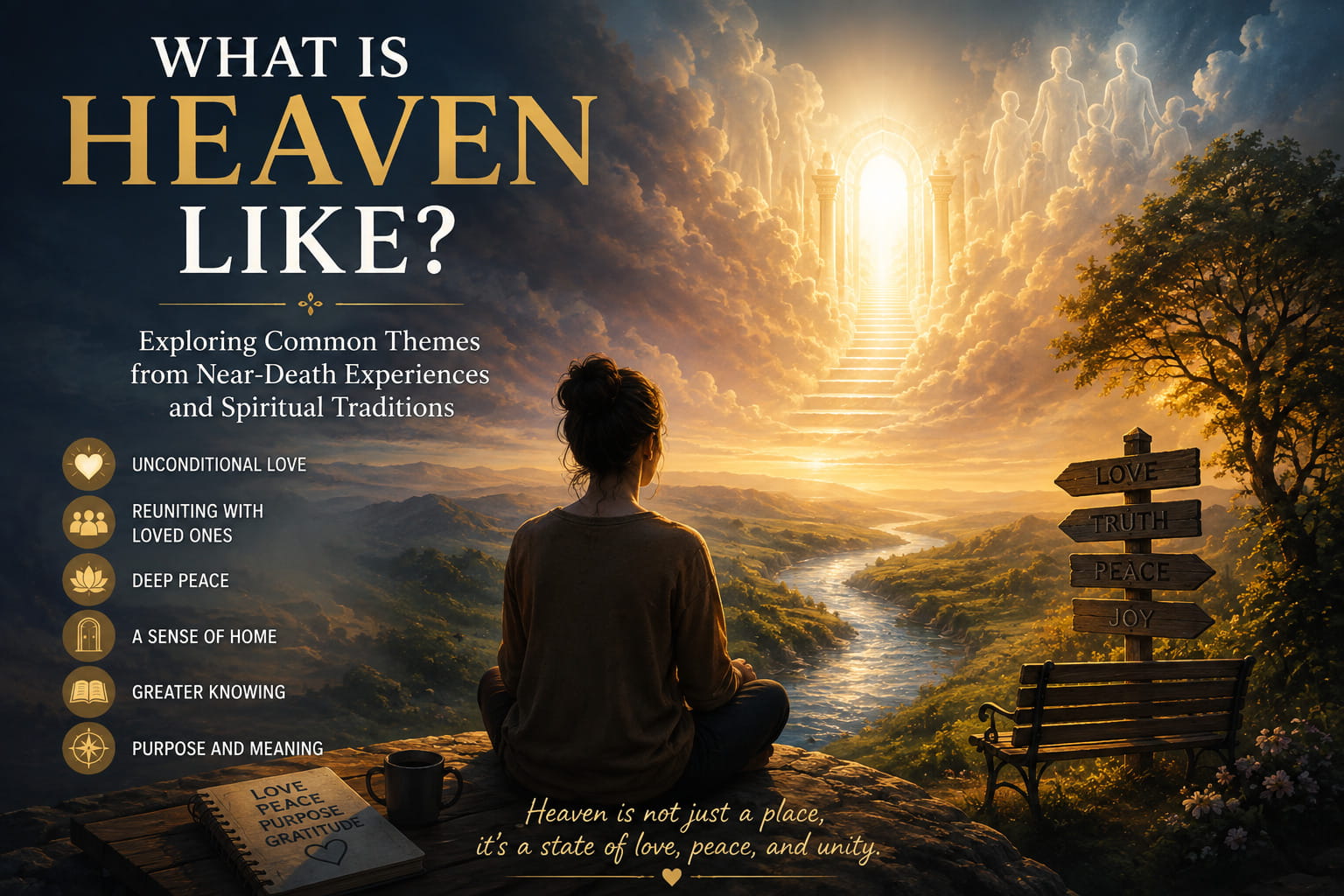
Understanding Near-Death Experiences
A near-death experience is a profound event reported by people who have survived life-threatening situations such as cardiac arrest, serious accidents, or medical emergencies.
Not everyone who comes close to death reports an NDE, but those who do often describe experiences that feel incredibly real sometimes even more vivid than ordinary life.
Commonly reported elements include:
- A feeling of leaving the physical body
- Moving through a tunnel or darkness
- Seeing a brilliant light
- Feeling overwhelming peace
- Encountering deceased loved ones
- Meeting spiritual beings
- Experiencing a life review
- Feeling reluctant to return to earthly life
While medical researchers continue investigating possible explanations, these experiences have sparked ongoing discussions about consciousness and the possibility of life after death.
Heaven as a Place of Peace
One of the most consistent themes across both spiritual traditions and near-death experiences is an overwhelming sense of peace.
People frequently describe the absence of:
- Fear
- Pain
- Anxiety
- Anger
- Loneliness
Instead, they report experiencing complete calm and emotional security.
Many say that earthly worries simply disappear, replaced by a deep feeling that everything is exactly as it should be.
Religious traditions often describe heaven similarly as a realm free from suffering, sorrow, and conflict.
Although descriptions differ, peace remains one of the most universal characteristics.
An Experience of Unconditional Love
Perhaps the most frequently reported aspect of near-death experiences is an indescribable feeling of unconditional love.
Individuals often explain that the love they experienced exceeded anything they had ever known during earthly life.
This love is described as:
- Complete acceptance
- Total understanding
- Infinite compassion
- Perfect forgiveness
- Absolute belonging
Many spiritual traditions also portray heaven as existing in the presence of divine love.
Whether understood as God’s love, universal compassion, or ultimate unity, love appears as a central theme across many belief systems.
Encounters with Light
Reports of brilliant light appear in countless near-death experiences.
Unlike ordinary light, people often describe it as warm, intelligent, comforting, and alive.
Some interpret the light as:
- God
- Angels
- Divine presence
- Universal consciousness
- Pure spiritual energy
Interestingly, many individuals say they did not communicate with the light through spoken words. Instead, communication seemed immediate, complete, and beyond ordinary language.
Spiritual traditions around the world have long associated divine reality with light, symbolizing wisdom, truth, purity, and eternal life.
Meeting Loved Ones
Many people who report near-death experiences describe encountering deceased family members or close friends.
These meetings are often characterized by joy, recognition, and emotional reunion.
Individuals commonly report feeling:
- Welcomed
- Safe
- Deeply loved
- Reassured
In many cases, loved ones appear healthy and peaceful regardless of the age or condition in which they passed away.
While interpretations vary, these experiences provide comfort to many people who hope that relationships continue beyond physical death.
The Life Review
Another recurring feature is the life review.
Rather than being judged by an external authority, many individuals describe witnessing important moments from their lives as if watching them unfold all at once.
During this review, people often experience events not only from their own perspective but also from the perspective of others affected by their actions.
This creates profound insight into how acts of kindness, compassion, and even small decisions influenced countless lives.
Many individuals return from these experiences believing that love, empathy, and relationships matter far more than material success.
Heaven Beyond Physical Space
Descriptions of heaven rarely resemble ordinary physical places.
Although some people report beautiful landscapes, gardens, rivers, or cities of light, many explain that heaven feels different from anything found on Earth.
Time often seems absent.
Distance becomes meaningless.
Communication occurs instantly.
People frequently describe feeling more alive, more aware, and more connected than ever before.
These descriptions suggest that heaven, if it exists, may represent a reality beyond our current understanding of space and time.
Perspectives from Different Spiritual Traditions
Although religions differ in their teachings, many share similar themes regarding heaven.
Christianity
Many Christian traditions describe heaven as eternal life in the presence of God, where believers experience joy, peace, worship, and freedom from suffering.
Islam
Islam teaches that Paradise is a place of peace, beauty, justice, and eternal reward for those who faithfully follow God’s guidance.
Hinduism
Some Hindu traditions view heavenly realms as temporary stages before reincarnation, while others emphasize liberation (moksha), the soul’s ultimate union with the divine.
Buddhism
Rather than focusing solely on heaven, Buddhism often teaches that enlightenment and freedom from suffering represent the highest spiritual goal. Some Buddhist traditions also describe heavenly realms that beings may experience.
Other Spiritual Perspectives
Many modern spiritual philosophies describe heaven less as a location and more as a higher state of consciousness, complete unity, or profound spiritual awareness.
Despite theological differences, themes of peace, compassion, and transcendence appear repeatedly.
Scientific Perspectives
Scientists continue studying near-death experiences from neurological, psychological, and medical viewpoints.
Some researchers suggest NDEs may result from changes in brain activity during extreme stress or oxygen deprivation.
Others argue that current scientific explanations do not fully account for every reported experience.
At present, no scientific consensus exists regarding whether near-death experiences represent evidence of an afterlife or extraordinary brain processes.
Because of this uncertainty, both scientific investigation and personal belief continue to play important roles in understanding these phenomena.
How These Experiences Change Lives
Regardless of their ultimate explanation, near-death experiences often lead to lasting personal transformation.
Many individuals report becoming:
- Less afraid of death
- More compassionate
- More forgiving
- Less materialistic
- More grateful
- More focused on relationships
- More interested in spiritual growth
These changes suggest that the experience itself, whatever its origin, profoundly influences how people choose to live.
Conclusion
What is heaven like? No one can answer with complete certainty, and different religions and philosophies offer different interpretations. Yet the remarkable similarities found in near-death experiences and spiritual traditions are difficult to ignore.
Descriptions of overwhelming peace, unconditional love, radiant light, joyful reunions, and deep spiritual connection appear across cultures and generations. Whether viewed as glimpses of an afterlife, symbolic experiences, or profound psychological events, these accounts continue to inspire hope and reflection.
Ultimately, the question of heaven invites us to think not only about what may come after death but also about how we live today. If kindness, compassion, forgiveness, and love are the qualities most often associated with heaven, perhaps embracing those values in our daily lives is one meaningful way to bring a little bit of heaven into the world around us.