

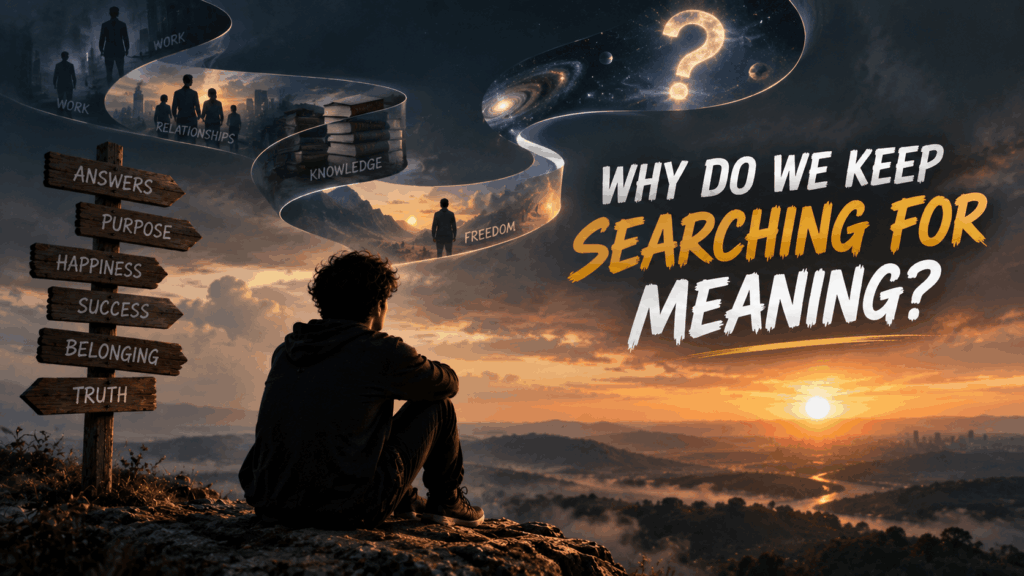
If Life Is Just About Surviving, Why Do We Want More?
You can have food.
You can have a home.
You can have a job.
You can have money.
You can have people around you.
And still wake up one morning wondering:
“What is all of this for?”
That question has followed humanity for thousands of years.
Long before smartphones, social media, and modern cities, people looked at the stars and asked the same basic questions:
Why are we here?
Where did we come from?
What should we do with our lives?
Does life have a purpose?
Maybe the most interesting thing about being human isn’t that we can survive.
It’s that survival doesn’t seem to be enough.
We Want More Than Just to Stay Alive
Animals spend much of their lives finding food, avoiding danger, reproducing, and protecting themselves.
Humans do these things too.
But we also write music.
We create art.
We build temples.
We fall in love.
We sacrifice for strangers.
We ask questions that have no obvious survival benefit.
A person can spend years trying to understand the meaning of existence even when there is no immediate practical reward.
Why?
Perhaps because human beings don’t just want to live.
We want our lives to mean something.
The Strange Question of Purpose
Think about someone who achieves everything they wanted.
They have money.
Success.
Recognition.
Comfort.
And yet they may still feel empty.
Why?
Because achievement and meaning are not necessarily the same thing.
You can accomplish a goal and immediately need another one.
You can buy something new and eventually get used to it.
You can become successful and still wonder what success was actually for.
This doesn’t mean ambition is bad.
It means we may be searching for something deeper than achievement.
Who Decides What a Meaningful Life Is?
Society has plenty of answers.
Get a good education.
Build a career.
Make money.
Own a home.
Get married.
Have children.
Become successful.
But what if those things don’t automatically create meaning for you?
And what if your definition of a meaningful life is completely different from somebody else’s?
Perhaps meaning cannot simply be handed to us.
Perhaps part of being human is discovering what we consider worth living for.
For one person, it may be family.
For another, creativity.
For another, helping people.
For another, discovering truth.
For another, God.
And for someone else, simply experiencing the beauty of being alive.
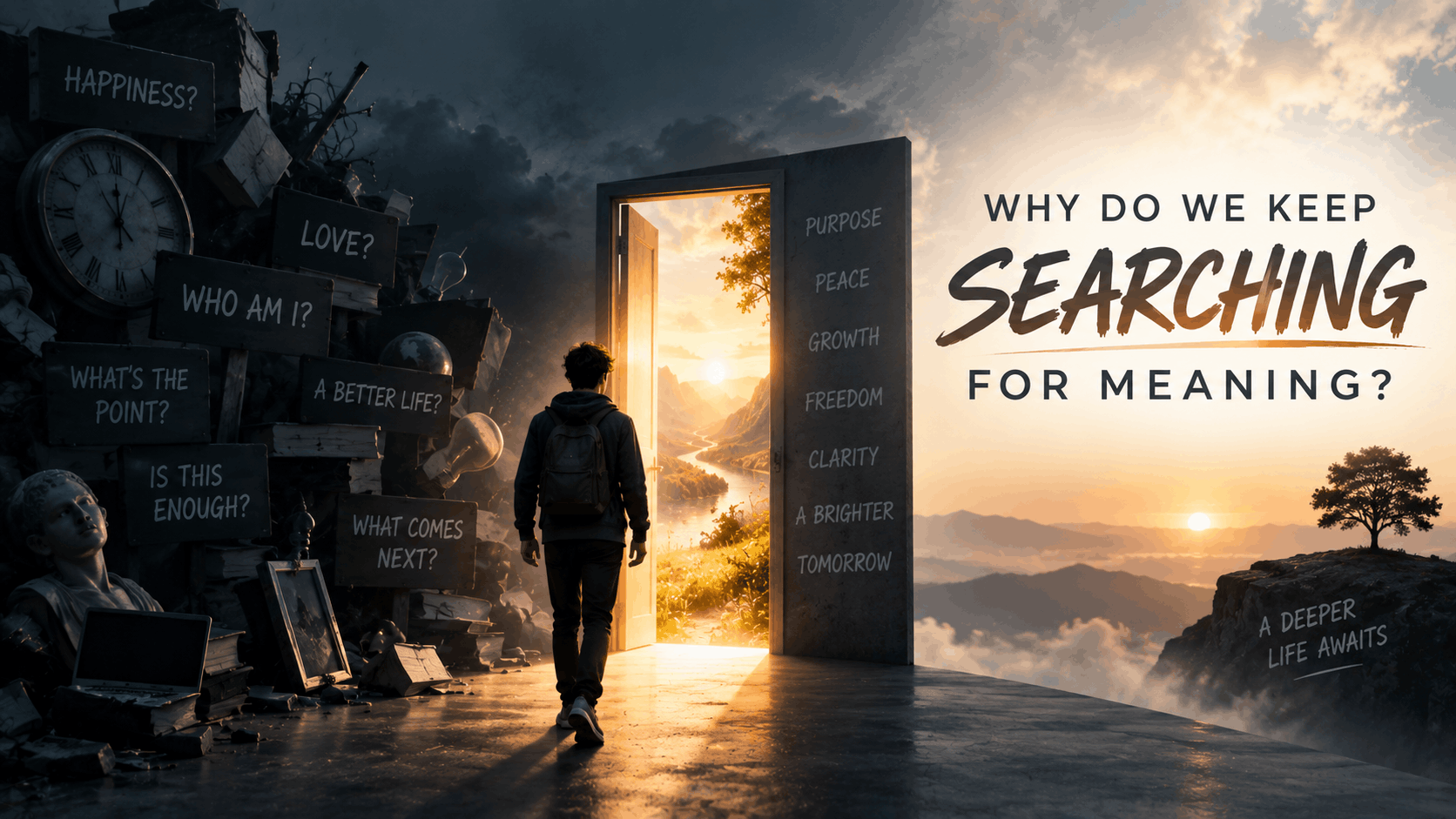
Does Meaning Come From God?
This is where the question becomes spiritual.
Many religions teach that life has a purpose connected to God.
Some people believe we are here to know God, love God, serve others, develop spiritually, or prepare for something beyond this life.
Other people don’t believe in God but still experience a powerful sense of purpose.
They may find meaning through relationships, compassion, creativity, knowledge, nature, or making the world better.
So perhaps the question isn’t simply:
“Do you believe in God?”
It is also:
“What gives your life meaning?”
And perhaps these two questions are connected—but not necessarily in the same way for everyone.
What Happens When Meaning Disappears?
When people lose a sense of meaning, life can begin to feel mechanical.
Wake up.
Work.
Eat.
Scroll.
Sleep.
Repeat.
The days become weeks.
The weeks become years.
Then one day you look back and wonder where the time went.
Maybe this is why moments of crisis can sometimes change people.
Losing a job.
Ending a relationship.
Becoming a parent.
Getting older.
Facing illness.
Experiencing loss.
These experiences can force us to ask questions we were previously too busy to ask.
What actually matters to me?
Maybe Meaning Is Found in Relationships
Think about the people you love.
Would your life feel equally meaningful if none of them existed?
Probably not.
Human beings are deeply relational.
A conversation can change your day.
A friendship can change your life.
A parent may sacrifice almost everything for a child.
Someone may risk their own safety to save a stranger.
These actions suggest something interesting:
Perhaps meaning is not only about what we get from life.
Perhaps it is also about what we give.
Maybe Meaning Is Found in Love
Love is difficult to define.
We can study its biology.
We can examine its psychology.
We can describe its chemistry.
But describing something doesn’t necessarily capture what it feels like to experience it.
Love can make people do extraordinary things.
It can make someone forgive.
Care.
Sacrifice.
Create.
Protect.
Change.
Perhaps this is one reason spirituality so often connects love with the meaning of life.
Not because love gives us an easy answer.
But because love takes us beyond ourselves.
What If There Is No Single Meaning?
This possibility can sound frightening.
Maybe the universe doesn’t come with a simple instruction manual saying:
“This is why you exist.”
But perhaps that doesn’t make life meaningless.
Maybe meaning can be discovered through how we live.
You can choose to make your relationships meaningful.
You can choose to help someone.
You can choose to create something beautiful.
You can choose to learn.
You can choose to become kinder.
You can choose to search for truth.
Meaning may not always be something we find.
Sometimes it may be something we create through our choices.
Stop Asking What Life Owes You
Here’s a different question.
Instead of:
“What can life give me?”
Ask:
“What can I give to life?”
Who can you help?
What can you create?
Who can you love?
What can you learn?
What problem can you make slightly better?
What kind of person do you want to become?
These questions can transform the way we see our existence.
A Seven-Day Meaning Experiment
For the next seven days, write down one answer each night:
What was the most meaningful moment of my day?
It doesn’t have to be dramatic.
Maybe you helped someone.
Maybe you had a genuine conversation.
Maybe you watched the sunrise.
Maybe you created something.
Maybe you learned something.
Maybe you simply experienced a moment of peace.
After seven days, look at your answers.
You may discover that the things giving your life meaning aren’t the things you expected.
Maybe the Search Is the Point
Perhaps humanity will never completely agree on the meaning of life.
Maybe there isn’t one answer that satisfies everyone.
But there is something beautiful about the fact that we continue asking.
Thousands of years later, we are still looking at the stars.
Still asking about God.
Still questioning death.
Still searching for love.
Still wondering why we are here.
Maybe the search itself is part of being human.
So don’t be afraid of the question:
“What is my life for?”
Sit with it.
Explore it.
Question what you’ve been taught.
Listen to different traditions.
Pay attention to what makes you feel alive.
And most importantly, look at how you are actually living.
Because perhaps the meaning of life isn’t hidden somewhere far away.
Perhaps it is being created right now—in the way you live, love, choose, and treat the people around you.